THE FUTURE IS RUSHING UPON US

We're in for a wild ride. Exponentially accelerating technological, cultural, and socioeconomic evolution means that every year will see more developments than the previous one. More change will happen between now and 2050 than during all of humanity's past. Let's explore the 21st century and ride this historic wave of planetary transition with a confident open mind.

Sunday, October 14, 2012

Economic Case for Scottish Independence

The 2014 referendum on independence organized by the Scottish National Party may create one of the world's wealthiest and most socially oriented republics.


SNP now holds majority in the newly created Scottish parliament. Their postmodern "quality of life" arguments for sovereignty (rather than those based on primordial blood roots and culture) are already being criticized by imperialist publications as having potential to set a negative precedent worldwide. Whenever self determination comes up, the popular consciousness still brings up images of a particular ethnic group, coalition of clans, an/or an occupied/splintered nation, etc as fighting for its chance in the sun. Kurdistan is one of the better known examples currently.

However, what if a part of the population convincingly argues that being their own nation will not right some prior wrong but just improve their quality of life and consolidate a certain regional and primarily socioeconomic and ideological cultural tendency. The people of Vermont with its (and only) socialist senator Bernie Sanders or New Hampshire with its libertarian "free state" streak are examples of regions that can offer this new type of argument. The example would go like this: "We want to be independent not because we have millennia old history as a unique ethnic group and long history of revolts and serious grievances (such as Kurds in eastern Turkey) but we feel that we do have different values that we evolved and that our way of life can become dramatically more efficient, streamlined, consolidated, and materially better if we ARE independent".

Considering:

1) Scotland's population of 5,200,000 people with 66 people per sq kilometer out of  78,387 sq km land area versus 345 people per sq km in the rest of the UK.

2) GDP per capita (nominal and PPP) being higher in Scotland than in the rest of UK on average (which is $38,591 and $36,728 respectively outside of Scotland)

3) Scotland has more claim to North Sea oil than the rest of the UK due to closer proximity and expertise in extraction.

4) Long tradition of socialist and social democratic government mindset and expenditures on the local population that makes Scotland closer to its Scandinavian neighbors in some respects than to its austerity pushing English master.

With these conditions, it may not become a new Norway (that only has 12 people per sq mile and PPP GDP per cap of $53,470) but it can definitely give Denmark a run for its money (which has 128 people per sq km and $37,000 PPP GDP per cap).

European Union has nothing to lose or fear by Scottish independence. Indeed, secession, separatism, and sovereignty questions begin to have less meaning when Republic of Ireland and Northern Ireland are both in the EU. When Basques may form their own country and still be in the Eurozone, independence does not have as much of a ripple effect anymore considering the current tendency of the world towards continental supranational economic unions. If anything, Eurocrats should encourage Scottish independence as it would declaw the old militarist UK a bit and the anachronism that is the British monarchy. 5.75%  of UK's GDP and 8.36% of its former "subjects" would be gone and the Trident submarine base near Glasgow either kicked out or charged rent. UK would become a more pliable (and hopefully less murderous and swaggering abroad!) partner with the EU if it is cut down to size. Its population would also be positively influenced by a republic being shared on one island giving anti-monarchists a boost. The remaining monarchies in Europe are becoming an embarrassment in 2012 not just for the continent but for the wider Western world.

The relatively domesticated population of UK needs a wake up call for reform themselves. Independent Scotland can have positive effects that go beyond its internal domestic politics. UK has long been the ringleader and legitimacy provider for many of the world's hereditary mafia "monarchies". UK's poodle of Qatar sending out mercenaries to Libya and currently to Syria to do UK's dirty destabilization work is but one of many examples. Middle East is currently in a free for all struggle between republican and monarchic blocks with UK playing the most unhealthy role in terms of which forms of government emerge victorious within the region (mentality appears to be that if you cant own it then you break it for the rest of the world).

The people of Scotland in 2014 thus have a unique chance to send a message that will be felt in ways we can't yet conceptualize. No longer will they be asked to fight abroad every few years and if London financial establishment wants to saddle them with some of its absurd debts, then perhaps SNP's Alex Salmond can provide an Icelandic answer to boot.

if only it was this easy more often


Stumble Upon Toolbar

Monday, October 8, 2012

Technocracy Movement Becoming Popular Again

There is a potent reason why the Western world is seeing alternative samizdat publications and sites spread like wildfire. The quote below encapsulates it and is from the online Technocracy Study Course (Available in PDF.  Emphasis on pages 121-143 if you don't have much time.) 


What is all the more shocking is that Technocracy Movement was very popular in the 1930s (the quote above is from the 1947 version) and stood as an all American alternative to some of the more European systems being proposed at the time. Educational conferences like the one pictured below were common and many prominent technocrats went on to serve in helping build the new FDRist state in the 1940s-1960s period.


The continental plans at the time appear grandiose to a post-industrial, post-cold generation but considering the pace in construction of continental economic unions and mega engineering being back in vogue due to China, we may return to similar thinking soon.


Stumble Upon Toolbar

Sunday, October 7, 2012

Eurasian Railroad Development

in a bit saner world...
Beijing to London freight delivery in 2 days as well as peaceful integration of Middle Eastern economies are some of many possibilities. Recent APEC meeting in Vladivostok should accelerate the long awaited development of Trans-Asian Railway project. 


Developing infrastructure has always been risky if you're not well protected by geography or by standing armies. The German-Ottoman/Baghdad-Berlin railroad link construction plans threatened British shipping interests and thus helped start the 20th century. And as Libyan experience shows, any small country outside Western alliances determined to become the "next Norway" of this or that particular region has a high chance of being bombarded by warplanes.

Having said that, transportation links are as essential as monetary unions when it comes to strengthening regional political integration. This point has been brought so often on this site that we may as well be called The Infrastructuralist. In fact, current political gridlock and disunity within USA would be a lot less intense if this union put as much effort into high speed freight/passenger delivery as is usually put into decades long military occupations. Transcontinental railroad continued being built even during American civil war and was instrumental in political integration of United States. That was big for its time but the key issue of the 21st century is connecting and creating harmony between the various poles of the multipolar world.

This primarily means socioeconomic and cultural integration of Asia and the West the way California, Texas, and New York (and more recently, France and Germany) have been united by transport. Elites understand the supranational symbiosis that transportation links bring and even the potential for a larger and more dynamic economy to swallow up neighbors. Because of that, we often even see reluctance to begin projects such as the Korea-Japan undersea tunnel even if it is mutually enriching.

Such notions need to be put to rest. Fears of freight links are not the same as fears of removing all trade protectionism. Tight railroad links and busy rail arteries can co-exist wonderfully with 20% tariffs (as shown by repeated successes of protectionism over the last 200 years). What is more dangerous than easy freight movement among neighbors is not so much mutual digestion by historical enemies. The danger is that lack of cooperation on transnational freight movements creates:

1) Economic and popular disharmony potentially leading to violence (some blood vessels in the regional body blocked, some deprived, some oversaturated, some non-existent, etc. inefficiencies, inequalities, bottlenecks, and chaos is the order of the day)

2) Stops spin off processes from getting off the ground whether economic (creating cooperation where economies of scale can be tapped) or political war averting ones (see below)

Full high speed railroad Eurasian integration is the obvious next step that United Nations saw as an essential violence preventing project for the largest land mass on earth. Projects of this nature always require soothing relations beforehand. Obviously Pakistan and India need to find ways to cooperate, as well as South and North Korea, Japan and Russia, Japan and South Korea, Iran and Arab neighbors, Israel and Egypt, Armenia and Azerbaijan, Georgia and Russia, Turkey and Russia, and Afghanistan sufficiently stabilized so as not to build railroads and pipelines around it.

In effect, in a world with nuclear weaponry, the shareholders of various railroad monopolies have to pressure for peace in order to get more business. High level governmental working groups approaching something as mundane as transborder high speed railroad development create a foot in the door towards preconditions for peace. Seoul and Pyongyang seem to be the early adopters of this understanding with railroad construction connecting their two countries (along with a free trade zone lubricating the project) being used as an ignition towards eventual reunification. Although some critics point to France and Germany being the most interconnected in terms of transportation in 1913, interdependence before conflict appears more of a historical exception rather than the rule.

post-scarcity civilization will think of how to tap
and transport resources from still
overlooked northern peripheries
Considering the current historical conditions in the Middle East (a patchwork of barely consolidated "states" each in its own historic development that roughly mirrors Europe anywhere from 1850s to early 20th century), a supranational government approach combined with links to indigenous civil society and business groups with infrastructuralist mindset and demands is essential to potentially prevent early 20th century Europe 2.0.

Let's quote from a previous article that compared 3 fastest rail lines in the world to better grasp a future Eurasian land bridge.

"The "best" is determined here by a combination of:

A) Average speed in between terminating points since the faster the distance covered, the more a train system cuts into air industry's profits. This in turn pushes airplane makers to conceptualize cheap travel by hypersonic passenger aircraft which in turn benefits humanity.


B) The distance that the high speed line covers since the longer the line, the bigger the project in terms of resources and parts and the more economies of scale are utilized. A society's commitment to triggering economies of scale for heavy industry shows its determination to improving the welfare of its citizens. Ultimately, going as big as possible with infrastructure projects (see Erie, Panama, Suez Canals and Transcontinental/Trans-Siberian railroads) is not just cheaper but creates mass employment (during transition to post-scarcity mechanization), rapidly stimulates real physical economy, and gives a super boost in wealth creation."


Industrial cartels behind the Chinese government also seem interested in free trade zones at the end of 3 major high speed Eurasian railways that are being proposed. India and southeast Asia being China's South America and Russia being China's Canada appears the immediate future for the region. Beijing needs to approach the situation in an integrative developmental language that FDR would have used to build common prosperity and avoid the imperialist mindset. The possibilities of freight entering North Korea from Russian Federation and then entering South Korean land to continue on via the underwater tunnel to Japanese consumers would do more for peace than 6 party talks ever did. Recent decision by the Kremlin to forgive 11 billion dollars of North Korean debt appears to be part of this particular mission. Energy and transportation projects can go through when borders are finally delineated and decades long issues forgiven. The Christian Orthodox Patriarch on a visit to Poland recently used the word he considered the most important. It was "forgiveness".

An economically booming region connected by Beijing, Tokyo, Taipei, Seoul, Pyongyang finally healing with high speed transport links would be an example to follow across the world from central Europe to Middle East to Africa. It is said people get used to a good thing very quickly and the Customs Union between Russia, Belarus, and Kazakhstan demonstrates that as passengers don't worry about being searched and stopped as their train crosses the border. As Mexico continues to grow in economic power, eventually the planners behind North American Union need to consider similar easing of restrictions and add high speed rail in addition to the high speed highway linking the continent.

Besides break of gauge, the way high speed tracks should be constructed should take into account possible future conversion to Mag-Lev standard. This means wide clearance around the track to allow parallel Mag-Lev construction once sufficient number of fission reactors are built to support it. Dual use construction or built in expansion for potential dual use is essential. Any type of transcontinental infrastructure built in 21st century should have major upgrades in mind to save on costs. Historically, once a major project begins, the tools for it itch to find use elsewhere as the pipe laying ships for Nord Stream already want to be used to lay pipes between Russian far east and South Korea and Japan. Initial investor capital creates a critical mass and a snowball effect for specialized machinery built for the original task. Governments and sovereign wealth funds are essential to create this type of ignition. Elites like Sarkozy, various think tanks, and The Pragmatist itself have already discussed an international Tobin tax to fund a truly global infrastructure development bank. It would rapidly help in what was previously thought as unapproachable "mega" projects such as terraforming the Sahara Desert, Gobi Desert, Central Asian Desert, etc.

2-3 trillion dollars (or 4% of world's GDP) to properly connect the far East and Western Europe will rapidly pay for itself through reversal of austerity mindsets, direct energy savings for the most populous landmass on earth, airplane construction cartels finally pushed towards development of cheap hypersonic freight and passenger jets, and greater lubrication for business than even economic and monetary unions. Even if European Union got its finances in order, it wouldn't function well if people still used horses and buggies. At the risk of the article sounding like another high speed commercial, there are also possibilities for passenger (and even freight trains!) that are always in motion and that unload their cargo onto another regional/city train system. Schemes like this can make high speed function smoothly with normal speed as well as allow experiments for non-stop high speed train systems of smaller size to operate within large urban areas.

As Immanuel Wallerstein's World Systems Theory and global climate change efforts (requiring world climate system approach) take hold in popular imagination, we'll see world systems finally applied to planetary transport and energy grids as we progress further.


Stumble Upon Toolbar

Wednesday, September 5, 2012

United Nations Extraterritorial Heritage Sites

Returning most major ancient artifacts to their countries of origin can be accomplished. With revenue sharing super museums with embassy type protection in international UN zones. 


The increasing wave of transnational requests to return invaluable pieces of history to their general geographic area opens up interesting opportunities for:

1) Novel tourist revenue sharing transnational mechanisms

2) Dramatically raising the power of UNESCO in its mission area of building global education and heritage preservation

3) General international cooperation in anthropology, archaeology, history, and architecture.

Imagine if most pieces of ancient Egyptian architecture and artifacts scattered in major (primarily Western) museums around the globe could be pulled into a sort of "mega" museum in Egypt. A truly immersive slice of an ancient world could thus be recreated with entire city blocks of a time long gone stuffed with artifacts. Considering the amount of region specific columns, building pieces, and statues that were looted from areas under former Ottoman, Chinese, Indian, etc control, entire Disney World type historical amusement tourist parks can be constructed. Rather than one giant entity like British Museum containing pieces of ancient Greece, India, or Egypt, it can contain all the most relevant pieces of historical Britain while super museums in Rome, Cairo, India, Athens can be fully stocked with their respective artifacts and expanded to contain much more.

Obvious major questions arise:

1) Why would countries ever part with artifacts that were acquired through either expensive archaeological efforts of their wealthy citizens, by conquest, or through superior geopolitical position?

2) Isn't it very dangerous to have all the eggs in one basket in terms of having all the biggest artifacts and pieces in one city in the case of man made or natural disaster?

3) On what grounds do we empower a specific nation state with custodial powers and allow it to potentially abuse the new monopoly on ancient physical history?

This is where UNESCO comes in. The World Heritage Convention currently provides for a reactive defense of cultural sites but UNESCO can flip that to become proactive creator of new heritage sites of sufficient transnational importance. Just as with proposals to make Jerusalem an international city, certain areas can become designated to become international heritage sites with extraterritorial protections of the entire 193 member body of the United Nations. In this manner, the host country, whether Italy, Greece, or Egypt can enjoy the full benefits of tourist traffic flying to its airports to get to the museum within its national borders while having the museum under long term control and protection of the international community. More mundane concerns of protecting the super museums from natural or man made catastrophe can be resolved with having the museums some ways away from major cities.

The powers holding on to these artifacts currently can be financially compensated with a proportional slice (based on amount of their contributed "sacrifice" of returning the loot) of the ticket sale revenue from the new international super museum complexes. Prominent countries holding the most amount of ancient history also happen to be on the UN security council. What was taken from areas such as the one under former Ottoman control can now be given back under an authoritative UN umbrella.

UN bureaucrats should always be on the look out on how to expand the powers of their organization. Focus on soft issue such as creation of new postmodern heritage sites allows precedent setting extraterritorial space building action that in the future can be utilized for more serious global projects involving energy, agriculture, and even industry. Creation of a giant Egyptian amusement park allows a foot in the door towards giving UN more teeth. Additionally, globe trotting professions like anthropologists, archaeologists, historians, etc can be provided with new streamlined travel and operational perks. An embryonic class of global citizenry does not necessarily need to wear helmets or always carry guns.


Stumble Upon Toolbar

Tuesday, September 4, 2012

2012 Election Year Retrospection: Failure of Obama Administration

The Pragmatist came about when the crisis began and now it is time to look back at what this site has gotten right politically, what wrong, and how election will wrap up


Barack Obama was put into office with Wall Street hedging 57% financial support towards him (it is down to 37% presently). It was widely expected that he will partially channel FDR and do for American finance top heavy capitalist system what FDR did for industry top heavy capitalist system of yesteryear. Namely, restructure it to extend its lifespan for a few more decades. The Pragmatist assumed that the nationalist minded elite clans (such as General Electric shareholders, etc) that put the current figurehead in, recognize that their privileges are in danger and will thus tackle the crisis vigorously and seriously. To keep milking the cow one needs to keep it alive and periodically update the milking equipment. Any such restructuring would require simultaneous dual push for a solid baseline industrial policy and dramatically different approach to liquidity provision.

The state hasn't pursued major rebuilding of the manufacturing base along with major restructuring of the financial sector (that is sitting/managing on top of the industry) to the degree that The Pragmatist predicted. There have been some mild efforts and platitudes concerning emulating a corporate/labor/state collaboration system like Germany but nothing serious yet. We can assume that this nationally self sabotaging behavior is due to a combination of two factors:

1) Major shareholders behind both political wings of the oligarchy are substantially internationalized so that the whole world is now considered a cow and that saving the cow on the North American continent is not as big of an issue anymore. The world's economic/financial system that US built is seen as sufficiently institutionalized that profits can continue to be made in a multipolar world. Greater amount of capital and energy is seen as required to save the American empire than to keep looting it and extracting from it. Thus..

2) The elites are emotionally ambivalent about which side to back. This allowed the status quo alliance of regional and internationalist minded shareholders behind the republican wing to reorganize and stage a current comeback. The nationalist Northeastern Yankee faction of the oligarchy simply does not have enough interpersonal power to modify the federal state apparatus anymore. In that they are very similar to the reform minded faction in the Soviet communist party in the 1980s (which was always stifled in its restructuring attempts by the reactionary majority that just favored "tightening some nuts and bolts" on an airplane that was struggling to even fly horizontally, much less lift up). This is explicitly seen in Obama faction's weakness towards the military generals to the present day.

Long term demographic trends still point to elite clans increasingly ruling from urban hubs rather than from wealthy suburban enclaves. The Pragmatist is probably correct in predicting a multidecade slide toward Brazil style authoritarian developmental system as the wealthiest cosmopolitans cluster in the coastal cities and as the interior descends into accelerated rot and South American style poverty. As for short term, even with democratic wing taking the brunt of the crisis (unlike GOP Hoover's administration that weathered 1929-1932), The Pragmatist incorrectly predicted in 2009 that Republicans will undergo a crushing defeat in 2012. That was due to 1) correctly predicting even more severe self cannibalizing infighting in GOP primary (and Ron Paul faction becoming co-equal to other major GOP factions) and 2) incorrectly predicting that the most strategic way forward for rich people generally (so called enlightened self interest and seeing writing on the wall) to preserve their system is major moves towards accommodation with the plebs. As we approach November, GOP would have underwent, if not a Mondale style defeat, but a paradigm shifting defeat if democrat backers took advantage of the crisis early on.

However, this dramatically changed with Citizens United, weakness, incredulity, and paralysis of New England power brokers, and seeming (at first glance irrational) inability of GOP backing elite clans to accommodate a new populist cultural paradigm shift (betting that they can use the crisis to hijack populism towards a new long term type of pro-corporate paradigm shift, similar to but qualitatively cruder than the one that began in early 1980s). At this point it is futile to disentangle multitudes of contributing factors that caused general paralysis ranging from 1) the passing ideological spasm of firebrush libertarianism cynically used by some elites in the last two years (similar to a rash of "genuine" communists in Soviet Union in the 1980s who insisted that the map is not the terrain) 2) need to continue to cause destabilization abroad to preserve force backed dollar hegemony (restructuring mentioned above would hinder militarism for a number of years) 3) A cancer patient type fear that the treatment is worse than the disease and that treatment will be even worse for social stability than kicking the can down the road.

We only have the present situation to work with.

Even in the headwinds of Citizens United changes in figurehead selection, Obama can still campaign on offering the 18 million opinion maker households (that generally decide elections) a Dow Jones that returned to almost precrisis levels and some reduction in stock market volatility from the 09-10 period. Paradoxically however, stabilization and normalization for elites and their butler class allowed both of them to relax and entertain the idea of a Romney presidency. This is a classic case of a loyal fall guy who went out of his way to help out and got discarded after the job. A sidenote: Obama can not be considered to have been a general weakling since he periodically showed surprising strength and spine when defending certain oligarchic interests against the progressive wing of the democratic party (as well as Obama's direct involvement in crushing civil unrest in fall of 2011). Another interesting sidenote: Citizens United may appear to overwhelmingly favor the corporate block but it also allows individual oligarchs new influence that they didn't have before. 2012 GOP primary infighting demonstrates that unlimited money in politics strangely generates a sort of top down pluralism among the elites (even if the pluralism is neo-feudal in nature).

In summer of 2009, it was predicted that major debt restructuring (well beyond the floating rate scheme planned currently) will need to occur before 2012 election or US risks keeping its economic system while seeing major changes in its political system. This will be tested in the next 4 years even if Obama is reelected. The Pragmatist's June 2009 (and admittedly safe!) advice to buy precious metals has generally proven correct with gold rising well above most asset classes from $950 an ounce to $1695 today and silver doubling from $15 to $32 today. Since austerity has never historically helped finances of countries, we will see where the can eventually lands.

It is time to put fiat where the mouth is with a very safe and tame prediction. Barring engineered economic jolts to help Romney or a paralyzing foreign crisis, Obama will probably narrowly win again considering roughly 1.5 million annual boomer mortality rate. Romney and Obama are tied now and are rather close in swing states. It appears that "the war on women" wedge issues will be utilized by the federal center of force to try to push Obama's coalition over the edge in terms of support. Considering that youth turn out will be depressed again, it is also a rather perverse race between amount of people recently disenfranchised by GOP state apparatuses, roughly 6 million boomers who died of old age in last 4 years (demographic that McCain won handily), and amount of minorities coming of voting age. Finally there is also the fact that it is a potent historic anomaly that Mitt Romney, a pure bred northerner, secured support of a party grounded in the south and it will be an even greater historical anomaly if he wins (looking at surprisingly regular election results going back to 1870s). The final 2 months should finally uncover some of that Obama spine as he uses federal apparatus backed stunts and that megaphone that was always at his disposal.


Stumble Upon Toolbar

Thursday, August 23, 2012

21st Century Skyscrapers, Vertical Farms, and Modular Construction

Marina Bay Sands makes a major first step towards
Skyscrapers as Pillars. Imagine these buildings
facing each other and...
The corporate cliche of synergy is often correct. In this case, architectural synergy between the commercial, residential, administrative, and agricultural skyscrapers all brought under one psychologically exhilarating roof.


Well not exactly one roof. We don't do car oil change where we eat. As noted in Skyscrapers as Pillars ™ concept article, an individual skyscraper does not necessarily need to be a world onto itself. Sorry Burj Dubai, you're very 20th century in terms of ego centrism.

However a few skyscrapers can create a microworld between them if arranged to enclose it and to take Singapore Marina Bay Sands and Gothic cathedral concept to a new level. This also flows with current international tendency to create innovation, technology, and business hubs from scratch in one sitting with a few showpiece skyscrapers clustering in a readily accessible central location.

A modern skyscraper has a lot of weight on its shoulders. From fighting architectural height fearing luddites as happened with Okhta Center in St Petersburg to promoting itself as an off the grid showpiece of green technology, a modern groundbreaking building has a lot to prove. Skyscrapers can cooperate in this regard.

The dual opposing tendencies of:

1) having building specialization (separate hyperspecialized structures) and

2) centralization of multiple functions within one giant corporate mall type super building

can be reconciled with Skyscrapers as Pillars.

St Paul's Cathedral
Rather than waste time and resources on architectural uniqueness of each skyscraper within a hub cluster, the rapidly constructed skyscrapers serving as pillars within a greater structure can be identical yet not look bland next to each other as they would if they were separate. This greatly decreases cost, saves on planning time, allows for rapid modular construction of different skyscraper pillar heights (depending on population of a city), AND actually increases the awe factor of the structure. We want to avoid the government project look when it comes to inspirational structures in the 21st century yet. Even if one is skeptical of the story concerning Chinese BSB's plan to construct a skyscraper taller than Burj Dubai within 90 days using prefabricated modules, the fact remains that modular construction is the future.

If a recently wealthy mineral rich country orders 30 Burj Dubai equivalents for a dozen cities, one factory can mass produce floors for all of them, greatly reducing the cost of each. The new Tata Motors car plant in India has a goal to produce $2,000 dollar cars. It will be able to manufacture 350,000 Nanos a year (think of Model-T's price tag of $21,000 or Volkswagen's $11,000 in today's dollars for comparison). Hyundai Motors plant is able to manufacture 1.53 million vehicles a year with one car made every 13 seconds and ship them out on massive container ships that its sister company manufactures at a shipyard a short distance away. Same principles can and will be applied to modular floors of showpiece net energy positive tall structures in this century whether residential, commercial, or agricultural. This finally allows rapid construction of entire compact cities from scratch and thus replacement of inefficient slum cities in most parts of the world.

Why the emphasis on arranging modular architecture to serve the pillar function?

In an increasingly socially fractured and unstable world, states can reclaim and command authority through architecture by having skyscraper pillars replace the function of the Gothic cathedral in a medieval village by having it be the most visible and awe/trust inspiring object around. As the public rejects the false choice between "cutting spending" and raising taxes/debt, it will be looking for ways to increase efficiency in other ways such as states directly owning certain essential productive and distribution functions. The new public space and government function arrangements will require popular legitimacy to become institutionalized and to take hold. Architecture greatly helps in this regard. Besides serving as crude awe inspiring visual propaganda the way cathedrals used to do, there is also the cheapness and efficiency of construction as mentioned above.

A centrally located Skyscrapers as Pillars construct already starts off as presenting a much cheaper and more effective/efficient government. Additionally, and with time perhaps crucially, there is also of course the function of each "pillar". One pillar (the one that stands out among the rest for that colorful touch) can be a massive vertical farm projecting a psychologically benign high tech agricultural function. The government can literally feed itself and provide surplus to others. Another pillar can be administrative and commercial, another can be residential (taking a horizontal elevator to your office is even better than taking a high speed MagLev train to get to work), while yet another serves to house research and development facilities, a hospital, a school, etc. The new technocratic regime can thus rapidly construct functionally beneficial and aesthetically pleasing houses of government (of various heights and sizes of course depending on the location).

Here is an example of a public skyscraper farm, suitable to support the government architecture of a medium sized city.

Every major plant food group is represented within a highly automated-mechanized industrially
mass produced yet organic and clean environment.

This is not to say that we want most of the city to live in a high tech vertical town. However, governments can reclaim their power from private oligarchies if their administrative centers are located within inspiring and hyper efficient self powered productive structures that create inner solidarity and sense of community among their numerous residents and people of surrounding areas. Various social events can be held in the main microworld created by the Skyscraper Pillar enclosure.

To help visualize this from the top, here's basic sketches.

We start off with


It is relatively easy to enclose a space and create an enormous "megaroom" microworld that would put the tallest church rooms to shame if at least one side of the modern skyscraper is straight all the way up. For super tall skyscrapers, Burj Dubai's triangular base currently serves as a role model of wind resistance stability for the tops of our pillars. Marina Bay Sands and high tech bridges show how we can roof the inside space and even create additional stability towards the top. For shorter skyscraper pillars (and as technology improves), the inside megaroom can eventually be widened or covered with ultralight carbon nanotube roofing. We are not asking for a small recreational area with a park, space observatory, and 1-2 story buildings to be on the roof just yet..


There are endless variations. It is of course also possible to continue taking lessons from Gothic cathedrals and create internal pillars. Here are 4 Burj Dubais from the top with a 5th wind protected core serving as supportive pillar to create more of a circular donut room (still highly impressive if you think about it).


Obviously roof stability challenges will be the main thing to overcome (consider how many incredible meters of leeway is given to skyscrapers to move around at the top currently). The importance of megarooms is described in the original article.

A final productive structure can be added in terms of a giant factory space (typical height, nothing grand, 5-10 stories in height, probably underground) that surrounds the pillars as a sort of partial fence. The Skyscraper Pillar structure can thus produce certain essentials such as medical supplies, clothing, tools, etc for personnel living and working within and for nearby city areas. This provides additional psychological base from which political legitimacy can be built. The overall complex thus becomes the heart and brain of the city. As mentioned previously, floor modules can be mass delivered by ship and rail, the way containers are currently.


Stumble Upon Toolbar

Wednesday, August 1, 2012

Modular Apartment Buildings

Click to Enlarge: Brooklyn developers are getting in on the act
having been inspired by China
Modular construction of residential high rises will rapidly aid in the major shift of American suburban population to urban areas. It also stands to provide sufficient amount of housing units to reduce social tensions in parts of the developing world where insufficient housing is a dangerous political issue.


The obscene and ridiculous fascination (although often interesting!) with shipping containers used as houses and office spaces shows that the public psyche approves of modular housing as a concept. Current container experiments may be fine as art projects or for disaster relief (although even that can be reconceptualized from the bottom up and mass produced) but real modular construction needs to be collectively thought about.

Military style techniques for rapid construction of modular housing were used to erect modern suburbia in the 1940s and 1950s starting with Levittown. Similar thought and application of elements of the military-industrial complex alongside Chinese construction companies can rapidly build new residential urban centers  in North America during the ongoing population shift there from suburbia. And throughout the world at large for that matter.

Ideally, most of the module would be printed in factories for extra speed and uniformity rather than assembled by robotic hands like cars. Modified supercargo ships can also be outfitted with printing factories to eliminate the need to load completed modules onto ships in the first place. Finished apartment buildings should allow for rapid disassembly/removal of modules every 20 years or so (to sell off/give away older modules to poorer areas of the globe the way old cars are sold off) and to allow replacement of modules in case of damage or fire.

Basic electrical, water, and insulation elements within the modules should also be readily accessible (for maintenance and appliance/furniture related modification) and introduced into the module during the printing process. Various insulating and protective coatings of nanomaterials are to be sprayed on just as naturally as on doors in a car assembly line process.

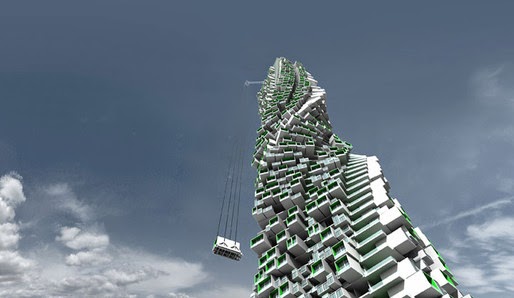
These days it is relatively easy to plan out a number of geometric module shapes to allow construction of much larger livingrooms and bedrooms from a few specialty modules. We're not talking a 50 story apartment project constructed of completely uniform boxes. Just like LEGO, diversity will arise from arrangement of a number of mass produced module parts. Some parts will be a lot more ubiquitous than others (think the equivalent of the connecting 6 hatch main module on the International Space Station that allows joining of other parts). But please no shipping container high rises for the love of god!

Those people choosing to remain in rural areas don't need to be discounted from this process. There is no need to remain in increasingly deteriorating wooden structures. Less high tech modular housing is currently primarily used for rural and suburban homes but it can be bumped up a notch in terms of materials from current cheap wooden models. Lets not forget that price comes down with economies of scale. To quote a previous article about modular hosing for rural areas:

"Modules are built "off the grid ready" with solar panels and clean water from air systems. A buyer modifies a module before buying the way one does a Dell computer and its parts. Since the price of a laptop went from thousands of dollars to 35 dollars (India also produced the world's cheapest car as well), mass production stands to do the same for housing. Entertainment and furniture systems can be added, subtracted, or reconfigured within individual modules. When one's kitchen becomes obsolete, the whole thing can be sold like a used car and replaced while keeping the rest of the house. This housing is not made of wood. People buy mass produced cars, yachts, and computers and there is no reason to not do the same for homes. It's about time to apply space tech for hyper efficient land living."


Some may complain that humans are not bees or ants to be "pigeonholed" like this. Well, current research shows that major urban human settlements are beginning to resemble massive ant colonies, However, when we understand the process, we can direct it and interject concepts like modularity into it to give extra psychological comfort, autonomy, and options for living space diversity. Currently as the world continues breakneck pace of urbanization, we're looking at roughly 300 mega cities being rapidly filled with corporate real estate developments or government projects. Paradoxically, single housing unit modularity or modularity of bedrooms, kitchens, bathrooms, etc allows for visual architectural diversity through rearrangement on an apartment complex by apartment complex basis. Outside, the residential high rises may look like relatively uniform glass/21st century concrete tombs but inside there would be all the diversity desired for families of various sizes and backgrounds.

Most importantly, the inner diversity of modular arrangement within the residential complex would take relatively similar amounts of time and electrical energy to erect (and of course dramatically much less time and energy used to construct even simple boring project-esque condominiums currently).

In developing parts of the world it would even be theoretically possible (if often not practically) to transplant an entire small village or hamlet right into a residential complex within an urban area with inner modular arrangement catering to the social dynamics of the entire village. In areas like India and China where thousands of villages have to be moved due to infrastructure development needs, such moves would be aided by flexibility that modular housing allows and would preserve social relations in strange, new, and unfamiliar urban environment. Modular construction can even thus reduce social anomie if done properly.

Module housing unit construction has to be dramatically faster than rise in world's annual birthrate. This means a number of mass assembly sites by deep water ports. Former or modified military naval construction installations serve as good springboards. For example, if Scotland declares independence from United Kingdom in 2014 and kicks out the Trident submarine fleet, the empty area would be perfect for a modular set up to serve along the coast of the North Sea region.

Whenever a slum is destroyed (as was the case with Rio Favela in Rio De Janeiro recently to make room for World Cup Infrastructure), modular units should be introduced as rapidly as possible to get back the hearts and minds of the locals. More authoritarian and thus speedy governments in Beijing and Moscow will probably (unfortunately) popularize this concept first before it takes off in the West. The West can preempt (these possibly too streamlined "ant-colony" efforts in the east) with large scale modular housing drive under the cover of environmentalism, green energy, smart grid integration, innovation hub construction, etc.

Modular housing should be sold as:

1) A public health issue (reducing rodents, filth, spread of disease)

2) A public safety issue through crime reduction/prevention (via psychological quality of life increase)

3) An economic issue (connecting rural and urban population to newest efficient energy, information, and utility grids)

4) An environmental issue (scraping and recycling older, less efficient, and less insulated housing)

5) A governance issue to create better social cohesion and possibly allow better census tracking to cater to populations politically

We need to go beyond this.
We can hope that once the concept is popularized sufficiently, we'll see apartment complex designs that go way and above the dreams of Scandinavian planners for government projects in the 60s and 70s. It is not enough to create a modernist looking high rise building, paint it in cheerful colors, stuff it full of poor people, and hope for the best.

What must be kept in mind going forward is generational renewal of modules, constant adaptation, experimentation, and application of newest mass production practices for module construction that would allow for additional renewal and experimentation within modules when it comes to shifting inside space, walls, furniture, and appliances.


This looks better :)
add a sprinkle of vertical farm modules and...

Stumble Upon Toolbar