THE FUTURE IS RUSHING UPON US

We're in for a wild ride. Exponentially accelerating technological, cultural, and socioeconomic evolution means that every year will see more developments than the previous one. More change will happen between now and 2050 than during all of humanity's past. Let's explore the 21st century and ride this historic wave of planetary transition with a confident open mind.

Sunday, October 7, 2012

Eurasian Railroad Development

in a bit saner world...
Beijing to London freight delivery in 2 days as well as peaceful integration of Middle Eastern economies are some of many possibilities. Recent APEC meeting in Vladivostok should accelerate the long awaited development of Trans-Asian Railway project. 


Developing infrastructure has always been risky if you're not well protected by geography or by standing armies. The German-Ottoman/Baghdad-Berlin railroad link construction plans threatened British shipping interests and thus helped start the 20th century. And as Libyan experience shows, any small country outside Western alliances determined to become the "next Norway" of this or that particular region has a high chance of being bombarded by warplanes.

Having said that, transportation links are as essential as monetary unions when it comes to strengthening regional political integration. This point has been brought so often on this site that we may as well be called The Infrastructuralist. In fact, current political gridlock and disunity within USA would be a lot less intense if this union put as much effort into high speed freight/passenger delivery as is usually put into decades long military occupations. Transcontinental railroad continued being built even during American civil war and was instrumental in political integration of United States. That was big for its time but the key issue of the 21st century is connecting and creating harmony between the various poles of the multipolar world.

This primarily means socioeconomic and cultural integration of Asia and the West the way California, Texas, and New York (and more recently, France and Germany) have been united by transport. Elites understand the supranational symbiosis that transportation links bring and even the potential for a larger and more dynamic economy to swallow up neighbors. Because of that, we often even see reluctance to begin projects such as the Korea-Japan undersea tunnel even if it is mutually enriching.

Such notions need to be put to rest. Fears of freight links are not the same as fears of removing all trade protectionism. Tight railroad links and busy rail arteries can co-exist wonderfully with 20% tariffs (as shown by repeated successes of protectionism over the last 200 years). What is more dangerous than easy freight movement among neighbors is not so much mutual digestion by historical enemies. The danger is that lack of cooperation on transnational freight movements creates:

1) Economic and popular disharmony potentially leading to violence (some blood vessels in the regional body blocked, some deprived, some oversaturated, some non-existent, etc. inefficiencies, inequalities, bottlenecks, and chaos is the order of the day)

2) Stops spin off processes from getting off the ground whether economic (creating cooperation where economies of scale can be tapped) or political war averting ones (see below)

Full high speed railroad Eurasian integration is the obvious next step that United Nations saw as an essential violence preventing project for the largest land mass on earth. Projects of this nature always require soothing relations beforehand. Obviously Pakistan and India need to find ways to cooperate, as well as South and North Korea, Japan and Russia, Japan and South Korea, Iran and Arab neighbors, Israel and Egypt, Armenia and Azerbaijan, Georgia and Russia, Turkey and Russia, and Afghanistan sufficiently stabilized so as not to build railroads and pipelines around it.

In effect, in a world with nuclear weaponry, the shareholders of various railroad monopolies have to pressure for peace in order to get more business. High level governmental working groups approaching something as mundane as transborder high speed railroad development create a foot in the door towards preconditions for peace. Seoul and Pyongyang seem to be the early adopters of this understanding with railroad construction connecting their two countries (along with a free trade zone lubricating the project) being used as an ignition towards eventual reunification. Although some critics point to France and Germany being the most interconnected in terms of transportation in 1913, interdependence before conflict appears more of a historical exception rather than the rule.

post-scarcity civilization will think of how to tap
and transport resources from still
overlooked northern peripheries
Considering the current historical conditions in the Middle East (a patchwork of barely consolidated "states" each in its own historic development that roughly mirrors Europe anywhere from 1850s to early 20th century), a supranational government approach combined with links to indigenous civil society and business groups with infrastructuralist mindset and demands is essential to potentially prevent early 20th century Europe 2.0.

Let's quote from a previous article that compared 3 fastest rail lines in the world to better grasp a future Eurasian land bridge.

"The "best" is determined here by a combination of:

A) Average speed in between terminating points since the faster the distance covered, the more a train system cuts into air industry's profits. This in turn pushes airplane makers to conceptualize cheap travel by hypersonic passenger aircraft which in turn benefits humanity.


B) The distance that the high speed line covers since the longer the line, the bigger the project in terms of resources and parts and the more economies of scale are utilized. A society's commitment to triggering economies of scale for heavy industry shows its determination to improving the welfare of its citizens. Ultimately, going as big as possible with infrastructure projects (see Erie, Panama, Suez Canals and Transcontinental/Trans-Siberian railroads) is not just cheaper but creates mass employment (during transition to post-scarcity mechanization), rapidly stimulates real physical economy, and gives a super boost in wealth creation."


Industrial cartels behind the Chinese government also seem interested in free trade zones at the end of 3 major high speed Eurasian railways that are being proposed. India and southeast Asia being China's South America and Russia being China's Canada appears the immediate future for the region. Beijing needs to approach the situation in an integrative developmental language that FDR would have used to build common prosperity and avoid the imperialist mindset. The possibilities of freight entering North Korea from Russian Federation and then entering South Korean land to continue on via the underwater tunnel to Japanese consumers would do more for peace than 6 party talks ever did. Recent decision by the Kremlin to forgive 11 billion dollars of North Korean debt appears to be part of this particular mission. Energy and transportation projects can go through when borders are finally delineated and decades long issues forgiven. The Christian Orthodox Patriarch on a visit to Poland recently used the word he considered the most important. It was "forgiveness".

An economically booming region connected by Beijing, Tokyo, Taipei, Seoul, Pyongyang finally healing with high speed transport links would be an example to follow across the world from central Europe to Middle East to Africa. It is said people get used to a good thing very quickly and the Customs Union between Russia, Belarus, and Kazakhstan demonstrates that as passengers don't worry about being searched and stopped as their train crosses the border. As Mexico continues to grow in economic power, eventually the planners behind North American Union need to consider similar easing of restrictions and add high speed rail in addition to the high speed highway linking the continent.

Besides break of gauge, the way high speed tracks should be constructed should take into account possible future conversion to Mag-Lev standard. This means wide clearance around the track to allow parallel Mag-Lev construction once sufficient number of fission reactors are built to support it. Dual use construction or built in expansion for potential dual use is essential. Any type of transcontinental infrastructure built in 21st century should have major upgrades in mind to save on costs. Historically, once a major project begins, the tools for it itch to find use elsewhere as the pipe laying ships for Nord Stream already want to be used to lay pipes between Russian far east and South Korea and Japan. Initial investor capital creates a critical mass and a snowball effect for specialized machinery built for the original task. Governments and sovereign wealth funds are essential to create this type of ignition. Elites like Sarkozy, various think tanks, and The Pragmatist itself have already discussed an international Tobin tax to fund a truly global infrastructure development bank. It would rapidly help in what was previously thought as unapproachable "mega" projects such as terraforming the Sahara Desert, Gobi Desert, Central Asian Desert, etc.

2-3 trillion dollars (or 4% of world's GDP) to properly connect the far East and Western Europe will rapidly pay for itself through reversal of austerity mindsets, direct energy savings for the most populous landmass on earth, airplane construction cartels finally pushed towards development of cheap hypersonic freight and passenger jets, and greater lubrication for business than even economic and monetary unions. Even if European Union got its finances in order, it wouldn't function well if people still used horses and buggies. At the risk of the article sounding like another high speed commercial, there are also possibilities for passenger (and even freight trains!) that are always in motion and that unload their cargo onto another regional/city train system. Schemes like this can make high speed function smoothly with normal speed as well as allow experiments for non-stop high speed train systems of smaller size to operate within large urban areas.

As Immanuel Wallerstein's World Systems Theory and global climate change efforts (requiring world climate system approach) take hold in popular imagination, we'll see world systems finally applied to planetary transport and energy grids as we progress further.


Stumble Upon Toolbar

Wednesday, September 5, 2012

United Nations Extraterritorial Heritage Sites

Returning most major ancient artifacts to their countries of origin can be accomplished. With revenue sharing super museums with embassy type protection in international UN zones. 


The increasing wave of transnational requests to return invaluable pieces of history to their general geographic area opens up interesting opportunities for:

1) Novel tourist revenue sharing transnational mechanisms

2) Dramatically raising the power of UNESCO in its mission area of building global education and heritage preservation

3) General international cooperation in anthropology, archaeology, history, and architecture.

Imagine if most pieces of ancient Egyptian architecture and artifacts scattered in major (primarily Western) museums around the globe could be pulled into a sort of "mega" museum in Egypt. A truly immersive slice of an ancient world could thus be recreated with entire city blocks of a time long gone stuffed with artifacts. Considering the amount of region specific columns, building pieces, and statues that were looted from areas under former Ottoman, Chinese, Indian, etc control, entire Disney World type historical amusement tourist parks can be constructed. Rather than one giant entity like British Museum containing pieces of ancient Greece, India, or Egypt, it can contain all the most relevant pieces of historical Britain while super museums in Rome, Cairo, India, Athens can be fully stocked with their respective artifacts and expanded to contain much more.

Obvious major questions arise:

1) Why would countries ever part with artifacts that were acquired through either expensive archaeological efforts of their wealthy citizens, by conquest, or through superior geopolitical position?

2) Isn't it very dangerous to have all the eggs in one basket in terms of having all the biggest artifacts and pieces in one city in the case of man made or natural disaster?

3) On what grounds do we empower a specific nation state with custodial powers and allow it to potentially abuse the new monopoly on ancient physical history?

This is where UNESCO comes in. The World Heritage Convention currently provides for a reactive defense of cultural sites but UNESCO can flip that to become proactive creator of new heritage sites of sufficient transnational importance. Just as with proposals to make Jerusalem an international city, certain areas can become designated to become international heritage sites with extraterritorial protections of the entire 193 member body of the United Nations. In this manner, the host country, whether Italy, Greece, or Egypt can enjoy the full benefits of tourist traffic flying to its airports to get to the museum within its national borders while having the museum under long term control and protection of the international community. More mundane concerns of protecting the super museums from natural or man made catastrophe can be resolved with having the museums some ways away from major cities.

The powers holding on to these artifacts currently can be financially compensated with a proportional slice (based on amount of their contributed "sacrifice" of returning the loot) of the ticket sale revenue from the new international super museum complexes. Prominent countries holding the most amount of ancient history also happen to be on the UN security council. What was taken from areas such as the one under former Ottoman control can now be given back under an authoritative UN umbrella.

UN bureaucrats should always be on the look out on how to expand the powers of their organization. Focus on soft issue such as creation of new postmodern heritage sites allows precedent setting extraterritorial space building action that in the future can be utilized for more serious global projects involving energy, agriculture, and even industry. Creation of a giant Egyptian amusement park allows a foot in the door towards giving UN more teeth. Additionally, globe trotting professions like anthropologists, archaeologists, historians, etc can be provided with new streamlined travel and operational perks. An embryonic class of global citizenry does not necessarily need to wear helmets or always carry guns.


Stumble Upon Toolbar

Tuesday, September 4, 2012

2012 Election Year Retrospection: Failure of Obama Administration

The Pragmatist came about when the crisis began and now it is time to look back at what this site has gotten right politically, what wrong, and how election will wrap up


Barack Obama was put into office with Wall Street hedging 57% financial support towards him (it is down to 37% presently). It was widely expected that he will partially channel FDR and do for American finance top heavy capitalist system what FDR did for industry top heavy capitalist system of yesteryear. Namely, restructure it to extend its lifespan for a few more decades. The Pragmatist assumed that the nationalist minded elite clans (such as General Electric shareholders, etc) that put the current figurehead in, recognize that their privileges are in danger and will thus tackle the crisis vigorously and seriously. To keep milking the cow one needs to keep it alive and periodically update the milking equipment. Any such restructuring would require simultaneous dual push for a solid baseline industrial policy and dramatically different approach to liquidity provision.

The state hasn't pursued major rebuilding of the manufacturing base along with major restructuring of the financial sector (that is sitting/managing on top of the industry) to the degree that The Pragmatist predicted. There have been some mild efforts and platitudes concerning emulating a corporate/labor/state collaboration system like Germany but nothing serious yet. We can assume that this nationally self sabotaging behavior is due to a combination of two factors:

1) Major shareholders behind both political wings of the oligarchy are substantially internationalized so that the whole world is now considered a cow and that saving the cow on the North American continent is not as big of an issue anymore. The world's economic/financial system that US built is seen as sufficiently institutionalized that profits can continue to be made in a multipolar world. Greater amount of capital and energy is seen as required to save the American empire than to keep looting it and extracting from it. Thus..

2) The elites are emotionally ambivalent about which side to back. This allowed the status quo alliance of regional and internationalist minded shareholders behind the republican wing to reorganize and stage a current comeback. The nationalist Northeastern Yankee faction of the oligarchy simply does not have enough interpersonal power to modify the federal state apparatus anymore. In that they are very similar to the reform minded faction in the Soviet communist party in the 1980s (which was always stifled in its restructuring attempts by the reactionary majority that just favored "tightening some nuts and bolts" on an airplane that was struggling to even fly horizontally, much less lift up). This is explicitly seen in Obama faction's weakness towards the military generals to the present day.

Long term demographic trends still point to elite clans increasingly ruling from urban hubs rather than from wealthy suburban enclaves. The Pragmatist is probably correct in predicting a multidecade slide toward Brazil style authoritarian developmental system as the wealthiest cosmopolitans cluster in the coastal cities and as the interior descends into accelerated rot and South American style poverty. As for short term, even with democratic wing taking the brunt of the crisis (unlike GOP Hoover's administration that weathered 1929-1932), The Pragmatist incorrectly predicted in 2009 that Republicans will undergo a crushing defeat in 2012. That was due to 1) correctly predicting even more severe self cannibalizing infighting in GOP primary (and Ron Paul faction becoming co-equal to other major GOP factions) and 2) incorrectly predicting that the most strategic way forward for rich people generally (so called enlightened self interest and seeing writing on the wall) to preserve their system is major moves towards accommodation with the plebs. As we approach November, GOP would have underwent, if not a Mondale style defeat, but a paradigm shifting defeat if democrat backers took advantage of the crisis early on.

However, this dramatically changed with Citizens United, weakness, incredulity, and paralysis of New England power brokers, and seeming (at first glance irrational) inability of GOP backing elite clans to accommodate a new populist cultural paradigm shift (betting that they can use the crisis to hijack populism towards a new long term type of pro-corporate paradigm shift, similar to but qualitatively cruder than the one that began in early 1980s). At this point it is futile to disentangle multitudes of contributing factors that caused general paralysis ranging from 1) the passing ideological spasm of firebrush libertarianism cynically used by some elites in the last two years (similar to a rash of "genuine" communists in Soviet Union in the 1980s who insisted that the map is not the terrain) 2) need to continue to cause destabilization abroad to preserve force backed dollar hegemony (restructuring mentioned above would hinder militarism for a number of years) 3) A cancer patient type fear that the treatment is worse than the disease and that treatment will be even worse for social stability than kicking the can down the road.

We only have the present situation to work with.

Even in the headwinds of Citizens United changes in figurehead selection, Obama can still campaign on offering the 18 million opinion maker households (that generally decide elections) a Dow Jones that returned to almost precrisis levels and some reduction in stock market volatility from the 09-10 period. Paradoxically however, stabilization and normalization for elites and their butler class allowed both of them to relax and entertain the idea of a Romney presidency. This is a classic case of a loyal fall guy who went out of his way to help out and got discarded after the job. A sidenote: Obama can not be considered to have been a general weakling since he periodically showed surprising strength and spine when defending certain oligarchic interests against the progressive wing of the democratic party (as well as Obama's direct involvement in crushing civil unrest in fall of 2011). Another interesting sidenote: Citizens United may appear to overwhelmingly favor the corporate block but it also allows individual oligarchs new influence that they didn't have before. 2012 GOP primary infighting demonstrates that unlimited money in politics strangely generates a sort of top down pluralism among the elites (even if the pluralism is neo-feudal in nature).

In summer of 2009, it was predicted that major debt restructuring (well beyond the floating rate scheme planned currently) will need to occur before 2012 election or US risks keeping its economic system while seeing major changes in its political system. This will be tested in the next 4 years even if Obama is reelected. The Pragmatist's June 2009 (and admittedly safe!) advice to buy precious metals has generally proven correct with gold rising well above most asset classes from $950 an ounce to $1695 today and silver doubling from $15 to $32 today. Since austerity has never historically helped finances of countries, we will see where the can eventually lands.

It is time to put fiat where the mouth is with a very safe and tame prediction. Barring engineered economic jolts to help Romney or a paralyzing foreign crisis, Obama will probably narrowly win again considering roughly 1.5 million annual boomer mortality rate. Romney and Obama are tied now and are rather close in swing states. It appears that "the war on women" wedge issues will be utilized by the federal center of force to try to push Obama's coalition over the edge in terms of support. Considering that youth turn out will be depressed again, it is also a rather perverse race between amount of people recently disenfranchised by GOP state apparatuses, roughly 6 million boomers who died of old age in last 4 years (demographic that McCain won handily), and amount of minorities coming of voting age. Finally there is also the fact that it is a potent historic anomaly that Mitt Romney, a pure bred northerner, secured support of a party grounded in the south and it will be an even greater historical anomaly if he wins (looking at surprisingly regular election results going back to 1870s). The final 2 months should finally uncover some of that Obama spine as he uses federal apparatus backed stunts and that megaphone that was always at his disposal.


Stumble Upon Toolbar

Thursday, August 23, 2012

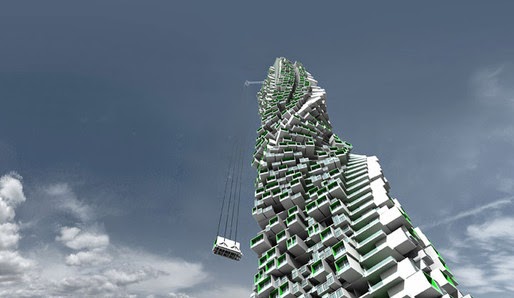
21st Century Skyscrapers, Vertical Farms, and Modular Construction

Marina Bay Sands makes a major first step towards
Skyscrapers as Pillars. Imagine these buildings
facing each other and...
The corporate cliche of synergy is often correct. In this case, architectural synergy between the commercial, residential, administrative, and agricultural skyscrapers all brought under one psychologically exhilarating roof.


Well not exactly one roof. We don't do car oil change where we eat. As noted in Skyscrapers as Pillars concept article, an individual skyscraper does not necessarily need to be a world onto itself. Sorry Burj Dubai, you're very 20th century in terms of ego centrism.

However a few skyscrapers can create a microworld between them if arranged to enclose it and to take Singapore Marina Bay Sands and Gothic cathedral concept to a new level. This also flows with current international tendency to create innovation, technology, and business hubs from scratch in one sitting with a few showpiece skyscrapers clustering in a readily accessible central location.

A modern skyscraper has a lot of weight on its shoulders. From fighting architectural height fearing luddites as happened with Okhta Center in St Petersburg to promoting itself as an off the grid showpiece of green technology, a modern groundbreaking building has a lot to prove. Skyscrapers can cooperate in this regard.

The dual opposing tendencies of:

1) having building specialization (separate hyperspecialized structures) and

2) centralization of multiple functions within one giant corporate mall type super building

can be reconciled with Skyscrapers as Pillars.

St Paul's Cathedral
Rather than waste time and resources on architectural uniqueness of each skyscraper within a hub cluster, the rapidly constructed skyscrapers serving as pillars within a greater structure can be identical yet not look bland next to each other as they would if they were separate. This greatly decreases cost, saves on planning time, allows for rapid modular construction of different skyscraper pillar heights (depending on population of a city), AND actually increases the awe factor of the structure. We want to avoid the government project look when it comes to inspirational structures in the 21st century yet. Even if one is skeptical of the story concerning Chinese BSB's plan to construct a skyscraper taller than Burj Dubai within 90 days using prefabricated modules, the fact remains that modular construction is the future.

If a recently wealthy mineral rich country orders 30 Burj Dubai equivalents for a dozen cities, one factory can mass produce floors for all of them, greatly reducing the cost of each. The new Tata Motors car plant in India has a goal to produce $2,000 dollar cars. It will be able to manufacture 350,000 Nanos a year (think of Model-T's price tag of $21,000 or Volkswagen's $11,000 in today's dollars for comparison). Hyundai Motors plant is able to manufacture 1.53 million vehicles a year with one car made every 13 seconds and ship them out on massive container ships that its sister company manufactures at a shipyard a short distance away. Same principles can and will be applied to modular floors of showpiece net energy positive tall structures in this century whether residential, commercial, or agricultural. This finally allows rapid construction of entire compact cities from scratch and thus replacement of inefficient slum cities in most parts of the world.

Why the emphasis on arranging modular architecture to serve the pillar function?

In an increasingly socially fractured and unstable world, states can reclaim and command authority through architecture by having skyscraper pillars replace the function of the Gothic cathedral in a medieval village by having it be the most visible and awe/trust inspiring object around. As the public rejects the false choice between "cutting spending" and raising taxes/debt, it will be looking for ways to increase efficiency in other ways such as states directly owning certain essential productive and distribution functions. The new public space and government function arrangements will require popular legitimacy to become institutionalized and to take hold. Architecture greatly helps in this regard. Besides serving as crude awe inspiring visual propaganda the way cathedrals used to do, there is also the cheapness and efficiency of construction as mentioned above.

A centrally located Skyscrapers as Pillars construct already starts off as presenting a much cheaper and more effective/efficient government. Additionally, and with time perhaps crucially, there is also of course the function of each "pillar". One pillar (the one that stands out among the rest for that colorful touch) can be a massive vertical farm projecting a psychologically benign high tech agricultural function. The government can literally feed itself and provide surplus to others. Another pillar can be administrative and commercial, another can be residential (taking a horizontal elevator to your office is even better than taking a high speed MagLev train to get to work), while yet another serves to house research and development facilities, a hospital, a school, etc. The new technocratic regime can thus rapidly construct functionally beneficial and aesthetically pleasing houses of government (of various heights and sizes of course depending on the location).

Here is an example of a public skyscraper farm, suitable to support the government architecture of a medium sized city.

Every major plant food group is represented within a highly automated-mechanized industrially
mass produced yet organic and clean environment.

This is not to say that we want most of the city to live in a high tech vertical town. However, governments can reclaim their power from private oligarchies if their administrative centers are located within inspiring and hyper efficient self powered productive structures that create inner solidarity and sense of community among their numerous residents and people of surrounding areas. Various social events can be held in the main microworld created by the Skyscraper Pillar enclosure.

To help visualize this from the top, here's basic sketches.

We start off with


It is relatively easy to enclose a space and create an enormous "megaroom" microworld that would put the tallest church rooms to shame if at least one side of the modern skyscraper is straight all the way up. For super tall skyscrapers, Burj Dubai's triangular base currently serves as a role model of wind resistance stability for the tops of our pillars. Marina Bay Sands and high tech bridges show how we can roof the inside space and even create additional stability towards the top. For shorter skyscraper pillars (and as technology improves), the inside megaroom can eventually be widened or covered with ultralight carbon nanotube roofing. We are not asking for a small recreational area with a park, space observatory, and 1-2 story buildings to be on the roof just yet..


There are endless variations. It is of course also possible to continue taking lessons from Gothic cathedrals and create internal pillars. Here are 4 Burj Dubais from the top with a 5th wind protected core serving as supportive pillar to create more of a circular donut room (still highly impressive if you think about it).


Obviously roof stability challenges will be the main thing to overcome (consider how many incredible meters of leeway is given to skyscrapers to move around at the top currently). The importance of megarooms is described in the original article.

A final productive structure can be added in terms of a giant factory space (typical height, nothing grand, 5-10 stories in height, probably underground) that surrounds the pillars as a sort of partial fence. The Skyscraper Pillar structure can thus produce certain essentials such as medical supplies, clothing, tools, etc for personnel living and working within and for nearby city areas. This provides additional psychological base from which political legitimacy can be built. The overall complex thus becomes the heart and brain of the city. As mentioned previously, floor modules can be mass delivered by ship and rail, the way containers are currently.


Stumble Upon Toolbar

Wednesday, August 1, 2012

Modular Apartment Buildings

Click to Enlarge: Brooklyn developers are getting in on the act
having been inspired by China
Modular construction of residential high rises will rapidly aid in the major shift of American suburban population to urban areas. It also stands to provide sufficient amount of housing units to reduce social tensions in parts of the developing world where insufficient housing is a dangerous political issue.


The obscene and ridiculous fascination (although often interesting!) with shipping containers used as houses and office spaces shows that the public psyche approves of modular housing as a concept. Current container experiments may be fine as art projects or for disaster relief (although even that can be reconceptualized from the bottom up and mass produced) but real modular construction needs to be collectively thought about.

Military style techniques for rapid construction of modular housing were used to erect modern suburbia in the 1940s and 1950s starting with Levittown. Similar thought and application of elements of the military-industrial complex alongside Chinese construction companies can rapidly build new residential urban centers  in North America during the ongoing population shift there from suburbia. And throughout the world at large for that matter.

Ideally, most of the module would be printed in factories for extra speed and uniformity rather than assembled by robotic hands like cars. Modified supercargo ships can also be outfitted with printing factories to eliminate the need to load completed modules onto ships in the first place. Finished apartment buildings should allow for rapid disassembly/removal of modules every 20 years or so (to sell off/give away older modules to poorer areas of the globe the way old cars are sold off) and to allow replacement of modules in case of damage or fire.

Basic electrical, water, and insulation elements within the modules should also be readily accessible (for maintenance and appliance/furniture related modification) and introduced into the module during the printing process. Various insulating and protective coatings of nanomaterials are to be sprayed on just as naturally as on doors in a car assembly line process.

These days it is relatively easy to plan out a number of geometric module shapes to allow construction of much larger livingrooms and bedrooms from a few specialty modules. We're not talking a 50 story apartment project constructed of completely uniform boxes. Just like LEGO, diversity will arise from arrangement of a number of mass produced module parts. Some parts will be a lot more ubiquitous than others (think the equivalent of the connecting 6 hatch main module on the International Space Station that allows joining of other parts). But please no shipping container high rises for the love of god!

Those people choosing to remain in rural areas don't need to be discounted from this process. There is no need to remain in increasingly deteriorating wooden structures. Less high tech modular housing is currently primarily used for rural and suburban homes but it can be bumped up a notch in terms of materials from current cheap wooden models. Lets not forget that price comes down with economies of scale. To quote a previous article about modular hosing for rural areas:

"Modules are built "off the grid ready" with solar panels and clean water from air systems. A buyer modifies a module before buying the way one does a Dell computer and its parts. Since the price of a laptop went from thousands of dollars to 35 dollars (India also produced the world's cheapest car as well), mass production stands to do the same for housing. Entertainment and furniture systems can be added, subtracted, or reconfigured within individual modules. When one's kitchen becomes obsolete, the whole thing can be sold like a used car and replaced while keeping the rest of the house. This housing is not made of wood. People buy mass produced cars, yachts, and computers and there is no reason to not do the same for homes. It's about time to apply space tech for hyper efficient land living."


Some may complain that humans are not bees or ants to be "pigeonholed" like this. Well, current research shows that major urban human settlements are beginning to resemble massive ant colonies, However, when we understand the process, we can direct it and interject concepts like modularity into it to give extra psychological comfort, autonomy, and options for living space diversity. Currently as the world continues breakneck pace of urbanization, we're looking at roughly 300 mega cities being rapidly filled with corporate real estate developments or government projects. Paradoxically, single housing unit modularity or modularity of bedrooms, kitchens, bathrooms, etc allows for visual architectural diversity through rearrangement on an apartment complex by apartment complex basis. Outside, the residential high rises may look like relatively uniform glass/21st century concrete tombs but inside there would be all the diversity desired for families of various sizes and backgrounds.

Most importantly, the inner diversity of modular arrangement within the residential complex would take relatively similar amounts of time and electrical energy to erect (and of course dramatically much less time and energy used to construct even simple boring project-esque condominiums currently).

In developing parts of the world it would even be theoretically possible (if often not practically) to transplant an entire small village or hamlet right into a residential complex within an urban area with inner modular arrangement catering to the social dynamics of the entire village. In areas like India and China where thousands of villages have to be moved due to infrastructure development needs, such moves would be aided by flexibility that modular housing allows and would preserve social relations in strange, new, and unfamiliar urban environment. Modular construction can even thus reduce social anomie if done properly.

Module housing unit construction has to be dramatically faster than rise in world's annual birthrate. This means a number of mass assembly sites by deep water ports. Former or modified military naval construction installations serve as good springboards. For example, if Scotland declares independence from United Kingdom in 2014 and kicks out the Trident submarine fleet, the empty area would be perfect for a modular set up to serve along the coast of the North Sea region.

Whenever a slum is destroyed (as was the case with Rio Favela in Rio De Janeiro recently to make room for World Cup Infrastructure), modular units should be introduced as rapidly as possible to get back the hearts and minds of the locals. More authoritarian and thus speedy governments in Beijing and Moscow will probably (unfortunately) popularize this concept first before it takes off in the West. The West can preempt (these possibly too streamlined "ant-colony" efforts in the east) with large scale modular housing drive under the cover of environmentalism, green energy, smart grid integration, innovation hub construction, etc.

Modular housing should be sold as:

1) A public health issue (reducing rodents, filth, spread of disease)

2) A public safety issue through crime reduction/prevention (via psychological quality of life increase)

3) An economic issue (connecting rural and urban population to newest efficient energy, information, and utility grids)

4) An environmental issue (scraping and recycling older, less efficient, and less insulated housing)

5) A governance issue to create better social cohesion and possibly allow better census tracking to cater to populations politically

We need to go beyond this.
We can hope that once the concept is popularized sufficiently, we'll see apartment complex designs that go way and above the dreams of Scandinavian planners for government projects in the 60s and 70s. It is not enough to create a modernist looking high rise building, paint it in cheerful colors, stuff it full of poor people, and hope for the best.

What must be kept in mind going forward is generational renewal of modules, constant adaptation, experimentation, and application of newest mass production practices for module construction that would allow for additional renewal and experimentation within modules when it comes to shifting inside space, walls, furniture, and appliances.


This looks better :)
add a sprinkle of vertical farm modules and...

Stumble Upon Toolbar

Sunday, July 29, 2012

Drone Delivery Service

Automated transportation systems in the sky are the next step from automation in the warehouses and on the highways


With all the excitement about robotic inventory management in warehouses (pioneered by the giant amazon.com's $775 million purchase of Kiva Systems) and creating distribution fleets of automated delivery trucks, it is easy to forget about the 3D frontier right above us.

Previously, I have noted that automated passenger and cargo blimps in the future obviously benefit from direct point A to point B travel. These would be robotic transport solar panel covered airships that land on water to convert H20 into hydrogen fuel and then proceed to make scheduled stops unhindered by traffic or friction with hard surfaces. The renaissance in airships is mostly led in advances in superstrong yet light nano metamaterials, military's need for transport and perpetual high atmosphere surveillance, and the bourgeois desires for a return of long distance luxury travel that is different from either large yachts or a private jets.

However, on the inevitable road towards automation in many aspects of industry, there is a simpler and quicker route to automated air transport on a mass scale. Quadrotor quadrocopters delivering bags of goods straight to your door, roof, or even your window. This is the ultimate foot in the door towards highways in the sky for much heavier vehicles transporting objects such as people, refrigerators, etc. There is already a joke service (?) about the taco delivering quadrocopter in the San Francisco bay area.  However, consider the amazingly versatile, high speed, and highly maneuverable capabilities of quadrocopters as demonstrated here, here, here, and below:


There are also Hexacopters capable of incredibly fast lift off and return. Watch it lift a Coca-Coca bottle around 9:30.

It is obvious that a larger version with a cutting edge battery can make a jump across the city rapidly to deliver a package and come back for recharging. Whether delivering fresh organic vegetables from a vertical farm in town, a pizza from a much larger automated pizza plant than the current pizza vending machines, or a certain size package from the postal service, possibilities for smooth rapid transport are endless. The booming private drone industry isn't going away. It somewhat reminds of the early popular rocketry and airplane experimentation in the early 20th century. Elon Musk equivalents are bound to come along to pull drone businesses together and cut out large swaths of the delivery human proles out of the equation. Clustering quadrotors vertically with a central cable for extra lift allows heavier object transport without taking too much horizontal space. We don't want a silly unwieldy looking contraptions like this just to deliver a television. Of course even that is preferable (along with quadrotor/small sleek blimp integration) if it saves on driver and energy costs and is able to deliver packages to rooftops of apartment buildings in a much more timely manner.


Here at The Pragmatist, automation is regarded as the greatest social disrupting force of the 21st century. Within automated production and distribution systems we see a total merger of the industrial and information age with corresponding questions about the problems it causes and potential long term consequences of these problems. As such, the faster automation and mechanization develops, the faster it forces collective thought on how to create a bridge between society of today and society of tomorrow. 

Consider the neighborhood pizza place. IF quality Brooklyn oven style pizza (or whatever foodie preference of the day) is mass produced by an automated pizza making hub according to the standards of some new food equivalent of six sigma quality control and the finished product is hopped across the city in minutes by a quadrocopter, then, if history is any guide, a lot of service jobs go out of business. And that is the point. The beauty of automation is that even the demeaning service sector is rapidly encroached upon. This begins a massive social dialogue on what to do next as a species. Many in United States for instance don't realize that when manufacturing companies return factories back from China, these factories are massively automated. Even recent manufacturing villains like Taiwanese FoxConn now have plans for replacing their suicide prone proles with a massive investment into 1 million robot units.

But back to quadrocopter delivery systems. Besides delivering lunch to iron cutters working in high rise construction buildings, these quadrotor wonders can actually aid in the construction of skyscrapers themselves by delivering building materials rather than continuing reliance on standard assembly of cranes on the upper floors. Of course these quadrotor craft would be dramatically larger in scale. Considering they are more aerodynamically stable and reliable than traditional heavy lift helicopters, large industrial quadrocopter lifters (modular so they can link up and form geometric chains when flying) appear like the they can aid in logistics for rapid construction efforts as being pioneered currently in places like China. We're familiar with the incredibly fast relay postal service that existed within the Mongol empire where a chain of race horse outposts was operated. One race horse rode to exhaustion and another picked up the package. A similar relay system for large automated industrial quadrotor vehicles can be implemented very rapidly and cheaply. Any parking lot can be a relay and a recharge station. Once again, the distance between relays is only limited by nanotechnology within best available lightweight industrial batteries to power these machines. Pools and ponds providing hydrogen for fuel cells are other potential rest stops.

You find it demeaning that a foreign immigrant drives a bicycle through the rain to deliver your food for a 2 dollar tip? Then call your lame do nothing congressman and ask for investment in automated quadrotor air delivery. 
Kiva Robots that are replacing thousands
of  warehouse workers daily help US 
narrow the robot gap

Stumble Upon Toolbar

Sunday, July 15, 2012

Building Cities of the Future

In addition to innovation hubs, building "governance hubs" by moving the capital cities to new locations would help many countries showcase their emergent economic strength. 


Creating a new high tech political management center further attracts investor capital, brings youthful foreign talent, diversifies country's vital urban zones by function, and stimulates an energetic burst of national renewal.

Before being accused that moving a political capital elsewhere is a ridiculous and impractical idea, lets look at two construction trends already occurring where function specific "micro-cities" are rapidly materializing around the world. Although these deal with finance and innovation for now, it is not too outside the box to speculate development of political micro-cities with cutting edge infrastructure to experiment in combining innovation and governance. There are already precedents for it.

Trend A: Financial Centers

It has become common practice for many "developing" countries (quotation marks since really, which country these days isn't in dire need of super rapid and constant development) to build financial downtowns from scratch that emulate southern Manhattan and City of London. Considering the 50 trillion dollar plus valuation of overall stocks floating worldwide and the similarly 50 trillion dollar plus global bond market, the temptation to attract a major slice of that fiat money is certainly understandable.

Some examples of popularly known construction efforts at more efficient capital management magnets include..

Dubai International Financial Center (although it is hard to overlook the hideous caste system slave labor used to build and run it)


Shanghai World Financial Center (Shanghai sure changed in 20 years)


Seoul International Financial Center (IFC)


Moscow International Business Center (a lot of these blatantly try to copy lower Manhattan waterfront view to appear "Western" enough for the promotional advertising photography and video)


Trend B: Innovation Hubs

The Pragmatist had previously touched upon an idea of building a true innovation hub via a concentric circle approach for an enclosed "Science Lab-Factory city" which would enable rapid reindustrialization within the Western world. This concept of a Research & Development to Prototype to Factory production assembly line city is not yet ready for prime time within popular imagination. It may eventually be attempted by some region if certain psychological obstacles are overcome. These obstacles include potential accusations of too much central planning and top down control in the beginning (even if the city is to be governed by direct democracy) and perceived regimentation that may result in creative stifling (since residential area lay out would also be a macro "human talent assembly line" within city's concentric circles). A fine line between human autonomy and desired speed of infrastructural construction/efficiency will need to be calibrated in the 21st century. Lessons from past FDRist and Soviet developmental approaches should be studied in order to create synergy of nourished individual autonomy and systems engineering approach so the former ends up aiding the latter in breakneck infrastructural efficiency rather than be stifled by it. Nobody wants to feel like a cog in the machine (even if the machine is run for the collective betterment of all versus fattening shareholder pockets).

In the meantime, rapidly developing countries are attempting to build their innovation hub micro-cities in the form of glorified and super expanded gated hybrids of commercial areas and college campuses. This creates an attractive investment showcase environment for foreign start ups, their bourgeois workers and families, and the capital necessary to sustain it all. 

In essence, we're seeing efforts to build MIT and Silicon Valley type environments from scratch and geared to specific broad clusters of industry. In fact, considering how much MIT has cooperated with these efforts, it may be time for MIT management to start thinking in terms of creating the first global technology university franchise (one may refer to this half jokingly as McDonaldsization of MIT, only in a good way...). These gated showcase cities of course have an umbilical cord both to the state and partially to their financial hub city brethren. This is absolutely necessary for now. The state should get a lot more financially involved in these projects and their supporting infrastructure since 21st century challenges simply cannot wait for usual organic business growth to provide solutions quickly enough.

Some recent examples include:

Masdar City in Abu Dhabi - A totally solar powered zero carbon footprint city and a hub for advanced green technology development.


Skolkovo in Russia - An attempt to replicate base of US technological innovation in the 1970s-1990s period from the top down and through a centrally planned effort. Even DARPA equivalent is in the works.


Now these do not begin to approach the scale of Tsukuba initiative that allowed Japan to become the most futuristic technological power on the planet in the late 20th century. Neither do they focus purely on breakneck scientific innovation and exploration like enclosed Soviet Naukograd cities did. However, these top down efforts can always be rapidly duplicated and paralleled if a very efficient design formula is found. 

It is said that college towns would become the new centers of civilization after a nuclear war due to the prevalence of labs, equipment, expert personnel, and scientific/technical manuals. Innovation hubs (even if their original design partially relies on attraction of gambling chips from transnational financial casinos of Wall Street, Hong Kong, etc.) can always be streamlined, clustered, elaborated upon, and quickly replicated if an effective and internationally and transculturally transplantable design is discovered. In a way, cities from scratch allow creation of a parallel embryonic global civilization in the shadows of the old one.

Which brings us to...

Trend C: ? -  Governance hubs as a "A Fresh Start" in the minds of the public, to create a new psychological atmosphere and sense of urgency for politicians, and encourage experimentation with Internet enabled democratic legislation. 

Creating a psychological feeling of a "fresh start" in the tired social psyches of many of the world's countries and their elites (particularly the stagnant Western world) by relocating key government buildings and functions to new governance hubs.

A number of nations have already moved their capitals around for geopolitical purposes. Most federal buildings were moved from Bonn to Berlin following Germany's reunification and recently there is even serious debate in Russia to move the political capital for the third time in a hundred years. Historically, urban decentralization has made a country stronger (one city being entertainment capital, one business, one political, one industrial, one cultural, etc). Germany is a good example of being a cluster of healthy regional capital level cities.

Notable examples of capitals being built anew from nothing are:

Brasilia, Brazil - Rapidly designed and built from scratch to be Brazil's futuristic political capital in the mid 20th century. It is closer to the center of the country than Rio, allowing better and closer geographic rule while stimulating nearby regions by opening up new trade, energy, and informational links.


Astana, Kazakhstan -  President Nursultan Nazarbayev decided to move his country's capital from Almaty to Astana in 1997. This allowed a fresh economic start to construct an architecturally modernist showcase city, create an enormous amounts of new jobs, reinvigorate an entire region of the country, and psychologically enable new thinking in officials that settled there.

Once again, capital was moved to a more central location in the country for better national consolidation (think moving key federal government functions away from tired and hated Washington DC and closer to the center of United States so USA's occupied peripheries like Texas and California don't resent being ruled from thousands of miles away). 


Real investment will flow once the world's elites see that a country has a futuristic vision for rapid growth and development that takes advantage of very capital intensive infrastructural projects that have the government elites' committed long term backing. 

Moving the nation's capital to a new more central location fed by high tech infrastructure and treasuries undivided support accomplished this. The trends of constructing financial and innovation hubs will spawn a final binding tendency that better manages the entire process holistically. Humans are primarily shaped by their environment and that includes politicians. Elderly men and women sitting in crumbling buildings hundreds of years old will not do as much innovative managerial thinking as those who legislate in a fresh high tech development (preferably one that has structures with high ceilings). 

Picking the right location for the move is a story in itself as it would stimulate unprecedented series of cultural, social, and economic ripples from the entire country.

Stumble Upon Toolbar