THE FUTURE IS RUSHING UPON US

We're in for a wild ride. Exponentially accelerating technological, cultural, and socioeconomic evolution means that every year will see more developments than the previous one. More change will happen between now and 2050 than during all of humanity's past. Let's explore the 21st century and ride this historic wave of planetary transition with a confident open mind.

Showing posts with label china. Show all posts

Wednesday, February 24, 2010

Fastest Train Lines in the World


In the spirit of the previous pro-infrastructure article, lets take a look at the best high speed train systems in the world. We'll go by the widely used definition of high speed as at least 200 kph/125 mph. The "best" is determined here by a combination of:

A) Average speed in between terminating points since the faster the distance covered, the more a train system cuts into air industry's profits. This in turn pushes airplane makers to conceptualize cheap travel by hypersonic passenger aircraft which in turn benefits humanity.

B) The distance that the high speed line covers since the longer the line, the bigger the project in terms of resources and parts and the more economies of scale are utilized. A society's commitment to triggering economies of scale for heavy industry shows its determination to improving the welfare of its citizens. Ultimately, going as big as possible with infrastructure projects (see Erie, Panama, Suez Canals and Transcontinental/Trans-Siberian railroads) is not just cheaper but creates mass employment (during transition to post-scarcity mechanization), rapidly stimulates real physical economy, and gives a super boost in wealth creation.

As such, these 3 lines satisfy the criteria for greatness:

1) Wuhan-Guangzhou High Speed Line (China)
(922 kilometers and longest in the world)

Fastest rail line in the world going an average of 194 miles per hour(313 km/h)! Think of the inefficiency and time spent going to/from airports. The waiting to get on the planes and scanned/handled like cattle or being stuck in car traffic interrupted by a maximum speed limit of 55 miles per hour. The Wuhan-Guangzhou line uses two trains: CRH2 and CRH3. It opened for business just a couple months ago so you're looking at the cutting edge conventional non-magnetic land transport in the world.


2) Paris/Lyon-Marselle/St Charles TGV High Speed Line (France)
(750 kilometers long)
(Average speed between end points is 250 km/h or 155 mph!)

France hasn't been idle. They have beat the Chinese in test run speed records (even if now recently second place in average speeds for daily use) and seem determined to become European leader in train infrastructure. They are definitely in a good geographically central position to link up Spain's and Germany's growing networks. All their investment in nuclear power (close to 80% of France is nuclear powered) only helped with these energy intensive projects.


3) Shin-Osaka - Hakata Line (Japan)
(554 kilometers long)
(Average speed between end points: 242 kph/150 mph!)

Japan's Nozomi Shinkansen continues to deliver with a respectable third place. Japan was one of the world's earliest innovators in high speed train technology and is now in the process of moving on to large scale MagLev. This society's territory is one of the best networked in the world and yes, the are heavy into nuclear power as only fission today can deliver the power for true citizen comfort and land travel affordability.


Most of the world's homo sapiens have seen trains like these in science fiction movies and it is hard to wrap one's head around the sheer speeds these land rockets bring. It was really mind blowing to find out that some Chinese airlines cut their fares up to 80% to compete with the newest lines. Looking at these heavy industry marvels (operating on just standard rail gauge!) gladdens the heart and shows that macro scale technological and social progress continues at least in some regions of the planet. Japanese and the French are edged out of the top rank for now since Chinese started building their networks later and thus had newer tech in mind and on hand. We can ignore the magnetic levitation trains at the moment because they are still used on relatively short routes from airports and such.

China now has the world's longest high speed train network at 3,300 kilometers of high speed track as a sum of a number of prominent lines. Japan (2,459 km), France (1,700 km), Germany (1,290 km ) and Spain (1,270 km) follow behind. If one looks at populations of these countries however, France dominates with about 38,000 citizens per kilometer of high speed line while China lags far behind with 400,000 citizens per kilometer. France if of course helped in this since it has the highest % of its energy derived from a modern indigenous nuclear power plant system (it is no wonder why neutral Switzerland and France's neighbor was chosen as the site for the world's biggest and most energy intensive supercollider). Nuclear power infrastructure always goes hand in hand with next generation transport systems.

Shockingly, India, Russia, Brazil, and United States do not have any high speed lines at all as one would expect from countries of such geographic and economic size. We can expect a massive wealth outflow from them in the near future as they try to catch up by buying foreign technical help and/or fleets of trains. Of course it is still rather silly to see engineering marvels on dingy normal rail.


It makes a lot more sense for societies that lag in high speed networks to go straight into MagLev and go into it big. Here is a glimpse of the future spanning entire continents (and yes freight train MagLev will make deliveries of heavy industry parts more efficient than ever):


Stumble Upon Toolbar

Monday, September 21, 2009

Protectionism Works

Protectionism is what made every historically major country wealthy and powerful in the last 300 years (including the current free trade pushers like UK and USA). Protectionism should stop being a bad word as Japan and China can testify


The title may make the reader shake head immediately because a kind word is not often found with "protectionism" in the same sentence these days. Although United States industry was essentially built on protectionist tariffs (until 16th amendment of 1913 allowed federal government to start functioning via income tax instead of high tariffs on imports) the last 30 years involved continuous top down push of free trade propaganda. It is thus understandable that protectionism brings a negative psychological reaction even if there aren't ready made arguments to explain why.

If one looks at how world's key societies rapidly became wealthy and powerful (in the last 300 years), protectionism was always the dominating factor to help out native industry. France and England in 18th-19th century, United States, Japan, and Germany in 19th-20th century, and China in 20th are just some of the success stories.

In fairness, we can't overlook a number of small (population and physical size) states that are positioned to thrive in free trade by their geography (ocean reliant ports of Singapore, Hong Kong, Netherlands and Switzerland with its base in ancient Alps trading routes) which often also function as financial hubs. As far as large historically active players on the world stage, all became what they are due to basics like tariffs.

One may begin to argue that protectionism of old was different in that it was an ideological pillar of now "discredited" mercantilism. However, mercantilism never went away and still works wonderfully in more advanced forms in China and Japan (and even in Western Europe to a certain degree). Certainly we can understand the desire of a state to lower protectionist measures once its industries have sufficiently grown and benefited from them. We have seen England begin to push free trade propaganda in 19th century after its factories became the best in the world. Same pattern continued with United States (which had some of the most advanced and some of the only factories left standing) after World War 2.

One would think that United States would learn a lesson from slow decline of British Empire (late 19th century to 1960s) due to transition from mercantile protectionism to free trade and reserve currency imperialism. Surely it would have affirmed that lesson from the rapid rebirth (after the initial breathtaking success of their mercantile industrial expansion in late 19th century) of Japanese and German societies in the 1950s ad 1960s. It was crystal clear what works for national enrichment, job creation, national self respect, technological progress, and higher quality of life for the average citizen.

It can be summarized as follows:

1) Tariffs work, keeping out foreign competition and their advanced imports such as cars works, trade barriers work, high import duties work, allowing foreign companies to set up shop only in partnership with native companies/unions works

2) Free trade doesn't work as well as trade barriers historically when it comes to rapid national development and can even fatally drain a nation

For a number of years before the current economic depression hit, many old time free trade warriors like Nobel prize winning neoclassical economist Paul Samuelson began to realize that the global reallocation of industry can produce a domestic win-loss scenario for United States (especially in its trade contact with protectionist China) where the loss is so great as to be socially catastrophic. Samuelson used to have absolute faith in comparative advantage but his most recent major paper argues that free trade theory needs to be reformed for the modern world if it is to survive. Samuelson is too old (94) to meaningfully contribute at this point but major reallocation of his thought at this age shows the seriousness of free trade problems. One translated Der Spiegel interview has him mouth the thoughts familiar to anti-WTO protesters: that rising economic inequality within "globalizing" nation is a type of win-loss scenario that is unacceptable and stupid to be allowed to happen.

Another crusty dinosaur, Alan Greenspan, has mentioned a few years ago how rising inequality can threaten democratic functioning of United States. When free marketeers and capitalist internationalists utter words like these, it's the equivalent of John McCain saying that perhaps United States naval forces should be cut down in size. It's the equivalent of the Pope saying that perhaps some birth control should be introduced into church doctrine to save lives. Some of American elites (mostly in the nationalist democratic wing of the American oligarchy) have taken notice of this.

At this point, rapid and badly needed protectionist measures may shock United States into falling further into the economic abyss. Chinese retaliation and corresponding rise in cost of imports will not help United States get further away from risk of a hyperinflationary scenario. It would thus make sense for Barack Obama to sneak in defensive nationalist measures gradually. His recent decision to to impose a tariff on Chinese tires may be beginning of such an attempt. Tariffs on foreign made car batteries and materials/parts connected to industries decided to be"strategic" ( like green energy ) may follow. The way protectionism is introduced by the current administration will be vital for any chances of American rebirth within a generation.

When pound sterling began declining as reserve currency in the 50s and 60s along with British industry, London decided to cut off its foreign colonies for purposes of national regeneration and survival. United States needs to begin a similar process of disengagement from the world to match decline of the dollar as reserve. Since British Empire and United States were both in strong imperial position at the time of their full commitment to pushing free trade on the world, they found it easy to combine lack of protectionism with parasitic existence of unproductive consumption through the use of reserve currencies. In that sense, free trade "worked" for them for a while even as it impoverished small countries that were pushed to engage in it. This period is now coming to an end and a new model has to be formulated.

Some Europeans, like Emmanuel Todd, propose "protectionism on a continental scale" (the article is in French but is very readable with google translate). It may be argued that China already practices that to a degree in that it has the population and economy large enough for import restrictions without being crushed and impoverished. European Union definitely has what it takes for such an action especially if it coordinates with some nearby states like Russia. North American Union and South American Union may one day be such entities to effectively fight off Asian and European imports. Trade cannot be decoupled from production and effective production needs to be able to compete between itself rather than just exist in one part of the world where it's cheapest.

Let's hope some common sense prevails and more people question official orthodoxy of global unification by only one narrow "inevitable" route (the optimism of Thomas Friedman is now laughable in hindsight). Real globalization seems a lot more within reach when self enriching, wealth producing, continent wide economic unions do business with one another in a more equal way.

Lets remember what the 25th president of the United States William McKinley said about free trade at the end of 19th century when he affirmed a commonly held belief among American elites and citizens,

"Under free trade the trader is the master and the producer the slave. Protection is but the law of nature, the law of self-preservation, of self-development, of securing the highest and best destiny of the race of man. [It is said] that protection is immoral…. Why, if protection builds up and elevates 63,000,000 [the U.S. population] of people, the influence of those 63,000,000 of people elevates the rest of the world. We cannot take a step in the pathway of progress without benefitting mankind everywhere. Well, they say, ‘Buy where you can buy the cheapest'…. Of course, that applies to labor as to everything else. Let me give you a maxim that is a thousand times better than that, and it is the protection maxim: ‘Buy where you can pay the easiest.' And that spot of earth is where labor wins its highest rewards."

Stumble Upon Toolbar

Friday, August 21, 2009

International Subway Station Comparison

After exploring the state of one subway station in Manhattan, I decided to scout the internets for subway station aesthetics of regions that are not yet considered first world. As various research explains to me, the New York Subway is in its third world state of disrepair and neglect due to the huge amount of people living in poverty and severe budgetary mismanagement/corruption by public officials and elites. So I decided to explore the visuals of subways and metros from the key cities in BRIC (Brazil, Russia, India, China) block of developing nations since they are affected by similar problems to a larger degree.

CHINA SUBWAYS:

Beijing Subway (no this is not a set from a science fiction movie but an ultra sleek subway system that makes you feel that you're in an airport or a spaceport)


Shanghai Metro


Nanjing Metro


Guangzhou Metro


RUSSIA SUBWAYS:


Moscow Metro ( not this is not a modernist museum or some ancient castle but a subway system started in the 1930s)


Saint Petersburg Metro


Kazan Metro (capital of Tatarstan, a Muslim flyover province)


BRAZIL SUBWAYS:

Rio De Janeiro Metro


Sao Paulo Metro


INDIA SUBWAYS:


Delhi Subways


OOOPS!! Turns out that was not some slum in India but actually New York City stations in United States of America. Lets try this again.

INDIA SUBWAYS:


Delhi Metro


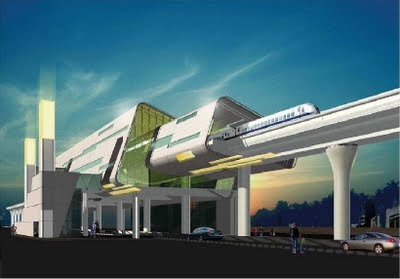
Well turns out Mumbai and Bangalore don't have an active metro system just yet but are building it. When it is completed, Bangalore for example, will have metro stations that look something like this according to the conceptual art:


Ah! My mistake again. I mixed up the conceptual art for Bangalore with 1990s designs which envision how Bronx and Queens stations will look like in 2009. The above are actually already built state of the art New York metro stations. Bangalore is in the process of building more third world type stations like these:


Thus concludes our quick tour around the developing world. Turns out that third world is focused too much on self respect, beauty, modernity, quality of life, and being in the 21st century. It'll never catch up with United States if it keeps building for its people and having pride. We need to explain to Chinese, Indians, Russians, and Brazilians that you can't nation build domestically like this. It is too expensive or something or other.

Either that or it is time for B.R.I.C. to become B.R.I.C.A.

P.S. Sweden beats all of them.


Stumble Upon Toolbar