THE FUTURE IS RUSHING UPON US

We're in for a wild ride. Exponentially accelerating technological, cultural, and socioeconomic evolution means that every year will see more developments than the previous one. More change will happen between now and 2050 than during all of humanity's past. Let's explore the 21st century and ride this historic wave of planetary transition with a confident open mind.

Showing posts with label iraq. Show all posts

Thursday, October 7, 2010

Guide to Effective Protests: Dress Code

Which picture shows people who are more serious?


The title was going to be "making demonstrations more effective" until I realized my previous titles increasingly began with ING suffix words. This reminded me that the trend of statements with ING suffix starters seemed to pick up pace under Bush. He would make many speeches in front of a background that would be endlessly covered with written tidbits like "rebuilding American families", "increasing opportunities", "making heartland strong", etc.

News organizations caught this propaganda flu as well. Since adding the ING suffix creates an action noun and conveys that continuous action is happening, it could very well be that GOP came up with very effective, psychological, and viral informational tool. Instead of definitive statements conveying a beginning and end such as "The act of 2006 caused this" we got streams of meaningless and cerebrally confusing "financing our future" which just told that vague action is happening nonstop. Perfect for 24/7 cable and do nothing politicians since definitive statements with an end would invite thought. Bush excelled at psych ops.

When talking about increasing effectiveness of protests, it is good to remember that the gathering of demonstrators is primarily a psychological propaganda tool for various media and apathetic middle class sections of the public. During the Bush era, the early Iraq war protests numbered in the hundreds of thousands. These protests were dramatically ineffective and not just due to 3 major media conglomerates deciding to ignore them. These anti-war gatherings were utilizing shockingly outdated methods (if they were ever that effective to begin with considering cultural backlash in 1970s).

The participants thought that the sheer numbers of people would be enough to catch the media's eye. Many of the baby boomer organizers have been using the same tactics that seemed to be successful decades ago and for which the establishment and society at large had developed a serious immunity. It may have been shocking and eye catching to have colorfully dressed hyper individuals in large numbers in 1960s in one place. In 2003 however, the insistence than protesters find their own unique way of expressing discontent became counterproductive since MSM was able to use it as a weapon of ridicule when it wasn't ignoring. It was easy pickings to zoom in on the strangest looking hippy or funniest paper meche statue.

Anybody who was exposed to this silly groan inducing spectacle could not have come away psychologically impressed. The actual target audience, politically dominant elderly and middle aged voters in the western world (majority of them were not on the side of earlier protesters in 60s/70s) were exposed to the wrong psychological marketing strategy and completely counterproductive anti-war propaganda.

The organizers would complain that just getting everybody organized enough to show up was an accomplishment. If they faced such critical organizational issues they should have spent serious energy on creating a perception of organization that was lacking. This is easily accomplished with a general agreement on what to wear and what color theme the demonstration should be.

It may sound silly but one just has to look back at US suffrage movement and the various CIA engineered "color revolutions" in eastern Europe in recent years. The green "movement" in Iran for instance was comprised of multitudes of various groups and previously unaffiliated individuals yet it miraculously became transformed into a monolithic "movement" with a simple color emphasis.

The effect of 2003 protests would have been multiplied dramatically if everybody showed up in their most formal wear and decided on a singular color. All it takes is for organizers to send a simple message to those attending such as "whatever you do show up in work pants/work skirt and a white shirt and wear a cheap blue headband or scarf, etc". When a reporter takes a picture of 50,000 people each dressed individualistically, it looks as you'd expect, just a horde of disorganized people. However a picture of 50,000 all dressed in office cubicle formal wear that also has blue headbands and occasional blue flags would be visually and psychologically stunning. It would:

1) Prevent reporters (both MSM and amateur) from singling out the strangest looking costumes and pretty much force more wide crowd shots since shots of so many people wearing the same are better photography in general (think psych ops of crowd shots in 2003 Ukraine and 2009 Iran). More media coverage is guaranteed.

2) Create the illusion of organization and "movement" which in turn invites giving the whole coalition of diverse groups an umbrella nickname (even simple tea bags can do this much less blue headbands)

3) Most importantly the psychological effect on elderly people (who see a crowd of crisp well dressed people of all ages) would go further in achieving the aim of the event in the first place. Even if the demonstration gets a derogative nickname like "bluebaggers/bluetesters" etc it would still give power to "movement" by putting it under one category. People like to lump things into categories.
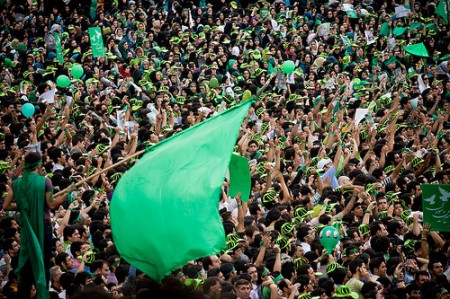

Doing something as simple and seemingly trivial as coordinating color and asking everybody to wear a white shirt automatically starts a process of integration where common themes and slogans are developed. It may be asking too much to also coordinate 3 simple phrases such as "Telling to End Afghanistan War" to utilize propaganda of repetition as a voice of the crowd. It may also be asking too much to have everybody at a protest shut up and walk in solemn silence for a mile to create a psychological sense of gravity in onlookers. It may definitely be too much to replicate the simple parade formation walking that suffragettes showed.

But when people feel seriously enough about something to gather in a large crowd (knowing that the crowd itself is a marketing tool) then they should also take the next step to demonstrate their seriousness instead of treating the event like a giant Halloween party, music festival, or socializing opportunity. Until common tricks to multiply message are used, American protesters will not show they are serious no matter how they feel on the inside. Then again, in today's climate next time there are that many people in the streets the catchy nickname they'd get may be pitchforkers.

Stumble Upon Toolbar

Saturday, May 9, 2009

Price of oil explains change of violence in Iraq more than American stabilization efforts ( "The Surge" of troops in Iraq was a fig leaf to cover up surrender to some of insurgent demands )

Surging price of oil up to summer of 2008 gave Iraqi government increasing resources to buy loyalty. Sunni insurgents realized they will lose in a protracted struggle and decided to exchange the weapon of Al Qaeda for American money and protection


It seems that fluctuations in the price of oil (and Iraqi people's reaction to it) is the best determinant whether Iraqi violence falls or rises. The Surge is thus not a success and the situation in Iraq is more precarious than most people realize.

We had it drilled into our heads that correlation is not causation so why does everyone automatically think that a few thousand extra troops did the trick in Iraq? Lets dissect the surge of these 20,000 troops. They were prudently put into more spread out urban checkpoints instead of the previous strategy of being sitting ducks in bases or patrolling ducks in humvees. They also came at a time when ethnic cleansing in Baghdad had made neighborhoods more homogeneous and thus better defended. Troops involved in the surge arrived past the peak oil equivalent of ethnic cleansing when it became increasingly costlier and more energy intensive for Shiites and Sunni kidnappers to get at each other with electric drills. Whereas before nationalist Moqtada Al Sadr could send out squads of people (and use the quantitative advantage of Shiites in Baghdad) to net maybe 50 bodies a day, now more planning and energy was required for same amount of kidnappers to kill say 30-40 a day. Nationalist Sunni insurgent leadership faced a similar problem as they exploited a religious ally of Al-Qaeda to inflict damage on numerically superior neighbors (think of it as Bronx using suicide bombers to stop hordes from Queens from overtaking them). The economics of ethnic cleansing began to work against it and it began to fizzle out just like many American oil wells in the 50s and 60s. Al-Sadr seemed to have gained the upper hand however.

Lets not forget the maze of concrete walls that was finally erected to further defend the repartitioned parts of the capital. Iraqis did rather brazen things but they're still humans and cant walk through walls. Reinforced concrete barriers work as Israelis have been showing for a while. The spirit of Cold War Berlin has finally found rest in a new host. So did adding extra troops to reinforce the police city state modeled on Fallujah end the scourge of ethnic cleansing and insurgency?

They did contribute in speeding up reduction of inter-ethnic violence that was already occurring by providing additional barriers. However, that's like saying that Americans won WW1 by themselves. Bush administration was keen to point to incredible drop in troop deaths in Anbar province but the extra troops in Anbar were not a significant force by any measure. They were even smaller than the tiny amount sent to patrol the capital of over 5 million people. England had 30,000 troops for years to guard against violence from IRA (whose active insurgent numbers were always in a few hundreds) and Russia had dozens of thousands to prevent isolated bands of rebels in Chechnya. The American surge of 20,000, split between a vast province and a populous city, was a laughable concept from the beginning.

But isn't the divide and conquer strategy of paying off former insurgents to not fight the Shiite dominated puppet government part of the bells and whistles that is "The Surge"? Isn't giving a few hundred dollars a month to destitute Sunni rebels (with a promise of more) a part of the Surge strategy to split the Sunni coalition of nationalist/secular fighters and the vicious foreign ideologues? That depends on the definition of the surge one is working with. If having a surge of money, to give to a former enemy so they fight a less negotiable common enemy, is all that was needed, then why send 20 thousand additional exhausted Americans in harms way? Couldn't some troops already there be shuffled around to bring bags of cash to those Arab tribes willing to become traitors and collaborators? Alright perhaps that was harsh. If anything, active co-operation with most of the insurgent leadership was a sign that Americans have lost against the rebellion and were honoring them as partners whose input was taken into account. You don't bargain with the head of a local rebel faction on how much to pay his men if you think you have a chance at killing him and his men or sending them off to prison. Perhaps the insurgent leadership thought it was more patriotic/less collaborationist to humiliate Americans with taking their money in return for not killing American soldiers at a rate of 5 a day. It's unfortunate that when US leadership finally decided to listen to advice of making alliance with former enemies against worse enemies it took nationalist Sunni leadership (rather than British leadership) to get such open ears.

Why would this be less collaborationist for Sunnis strategically speaking? Sure, Al-Qaeda fighters were getting too big for their breeches, terrorizing many Sunnis and imposing religious extremism in some areas that would never be tolerated under Saddam. But the net strategic benefit of them using psychologically weak young men as suicide bombings against Americans, Kurds, Al-Sadr's men, and Maliki's men outweighed the inconvenience of having them around. There was a more troubling development occurring globally that made Sunni insurgents betray their best ally of convenience and thus painfully sacrifice their most effective weapon. The price of oil spiked between 2005 and 2008 to levels not seen in a long time. Maliki's puppet regime began acquiring sufficient funds to pay off not just loyal police/army forces but also funds to start divide and conquering Sunnis without American assistance. Salaries of collaborators and armed men working for Maliki started to increase. 95% of Iraq's economy is oil based. The central government, that was formerly weak and dependent on Americans for protection, began to be able to increasingly not only protect itself but expand its influence. As the price of oil rose to over 140 dollars a barrel, Iraq has accumulated almost 80 billion dollars by the summer of 2008. Of which 30 billion are safely locked up in Manhattan,  

"The Baghdad government has about $30 billion deposited in the Development Fund for Iraq at the Federal Reserve Bank of New York"

Insurgents tried for a time to prevent such funding by continuously sabotaging the oil pipelines. It worked for a time but the price of oil kept rising and it even became profitable to start shipping oil by truck in armed convoys. The bulk of the efforts of the government, as well as the Americans, was focused to ensure protection of the export. Maliki, being an incredibly good strategist realized short term considerations, such as the quelling the rebellion and provision of social services, could wait and would be solved eventually through acquisition of sufficient funds. The rush to export as much as possible led to not only increase in corruption (resulting in occasional ludicrous events) but also brutalization and reduction in quality of loyalist forces.

Although many insurgents made money off the oil themselves to fund their operations, the government continued to make disproportionately more and gain a foothold in the minds of its numerically superior voting blocks. Central government could now stop pretending to be a puppet and start exerting itself to push Americans out so it could wipe out Baathist remnants. The current ruling Dawa party in Iraq started off as a terrorist organization and actively supported Iran during Iraq's war with it. The party that was for years protected by Americans actively and continuously betrayed Iraq nation state even as hundreds of thousands of Iraqis died and were maimed on the battlefield in the 80s. It was for years funded by Iran and is still indirectly helped by it. Such an impudent and now domestic power with the backing of many educated Shiites and friendliness to Iran was a far graver long term threat to Sunni nationalists than the 20 year old Americans occasionally venturing from their bases.

For the Bush administration, negotiating with insurgents who until the moment of negotiating were branded as mostly terrorists was a humiliating politically dangerous act that needed a good pitch to the American people. Admission of defeat against the rebels was marketed and sold as a change in American tactics and ordinary Iraqis rising up and throwing off the yoke of al-Qaeda. 20,000 extra troops were a fig leaf for this turning point in relations with the rebellion. Sunni insurgents bargained away their best weapon but gained more power, temporary peace, and better public relations by exterminating large quantities of foreign fighters.

Continuing to fight American forces (even with al-Qaeda's help) would keep weakening Sunni nationalists and allow Maliki to further consolidate, grow, and win. That was deemed unacceptable by insurgent leadership and they created a temporary alliance with the Americans to not only re-organize and humiliate Americans but also to make Maliki seem weaker and less popular in the minds of his supporters. Maliki appeared to be cutting a deal with Sunni militias through tacit consent of American plan and thus inability to shake off the image of a puppet.

Maliki successfully countered his pubic relations reversal by invading and occupying Sadr city. Why wasn't Muqtada al-Sadr able to prevent government's invasion of his home turf and the key Baghdad neighborhood of his power base? Before, when the price of oil was lower and the government less consolidated, Sadr effectively provided for some welfare and social needs of his supporters by creating a de-facto area of governance. He competed with Maliki's political faction by showing that he is 1) more nationalistic and determined to expel the Americans by having actually fought them twice 2) better able to protect Shiites from Sunni/al-Qaeda attacks and 3) more focused on improving quality of life for areas under his control. Times have changed and Maliki had more money to play around and offer to supporters so Sadr bowed to pressure to re-organize. Fighting Maliki was not an option at the time.

What does this mean in terms of the surge? It means that the possibility is there that the surge in the price of oil has done a lot more for Iraq's seeming drop in violence than extra 20,000 Americans. Now that the price of oil has fallen dramatically and might remain so indefinitely as the recession continues, Maliki is burning through his reserves (that he saved for a rainy day) at an incredible rate. Obama seems to realize how dangerous Iraq is to being destabilized again and that explains the slowness of the troop withdrawal. Sunni insurgents increasingly see American soldiers as good allies for protecting them during this period and are waiting for the oil based economy to come crashing down so they can exploit a weakness in Maliki's coalition. Recent increase in bombings and violence seems to indicate that just 6 months of low oil prices are already destabilizing the situation somewhat. It is not known how fast the billions of dollars to pay off loyalists will be spent. It's possible that Obama will try to use sudden reversal in Maliki's strength to force through major agreements between Sunnis and Shiites. Such an agreement was more difficult before without the drastic act of retaking Baghdad with American/formerly Baathist forces. Keeping a lid on the civil war from resuming earlier than Obama's re-election is key if Obama is to implement his long term agenda over 8 years and to choose his successor.


Stumble Upon Toolbar
