THE FUTURE IS RUSHING UPON US

We're in for a wild ride. Exponentially accelerating technological, cultural, and socioeconomic evolution means that every year will see more developments than the previous one. More change will happen between now and 2050 than during all of humanity's past. Let's explore the 21st century and ride this historic wave of planetary transition with a confident open mind.

Showing posts with label austrian economics. Show all posts

Wednesday, April 13, 2011

Comparing Deflationary and Inflationary Collapse


Both mainstream and dissident observers are coming up with "biflation" as an explanatory term to describe where we are as a planetary economy. That is a signal we're in a conceptual dead end (considering biflation has always been with us for the past half a century at least).


Some reactionary factions in the Western world desire a global return to a system of deflationary non-fiat industrial capitalism. I've began to write how "sound money" advocates are actually biting more than they can chew since deflation leads to collapse of capitalism a lot quicker than inflationary fiat funny money system. There's other very serious structural problems with the current world production and distribution system (such as machine efficiency rising faster than demand for workers) but lets focus on inflation and deflation first to see why there isn't a simple escape from current international fiat casino.


DEFLATIONARY COLLAPSE-
Caused by: Wage prices falling less fast than prices of goods
Result: Crisis of overproduction and profit collapse leading to shut downs of industry due to insufficient funds to run it, bringing corresponding misery.
Illustration of Industry versus "Consumer"/Worker deflationary cycle: 
                                                              

Industry makes KitchenBots (representing needed durable goods in general) and exchanges them for "sound" commodity backed currency. Consumers benefit in the mid stage of the cycle until overproduction leads to insufficient capital accumulation and horrendous social disturbance                                


1) Industry cycle begins


Pricey and new KitchenBot exchanged  >>>>>>>>>>>>>>
                                                    <<<<<<<<<<<<<< for 100 SoundBucks

Trickle in supply of KitchenBots begins some profit generation,  "consumers"/workers on average spend 2/3 of their total money on needed goods. Wealthier people/ early adopters create trickle of demand for the pricey good


2) Midstage of the industry cycle

Affordable and well known KitchenBot exchanged  >>>>>>>>>>>>>>
                                                            <<<<<<<<<<<<<< for 50 SoundBucks

Lots of supply as mass production slashes the price of the useful and desired KitchenBots yet profits increase on volume, workers on average spend 1/3 of their total money on goods (since their annual salary cuts are less drastic than cuts in the price of goods)


3) Final destructive stage of the industry cycle

Old and busted stamped out KitchenBot exchanged  >>>>>>>>>>>>>>
                                                            <<<<<<<<<<<<<< for 10 SoundBucks

Super supply and insufficient demand leads to inability of industry to make razor thin margins profitable. Profit collapses, capitalists cant afford to run factories and close them, laying off workers/"consumers". Workers on average spend 1/10th salary on goods yet they are now without income stream to afford the oversupply of goods all around them

Conclusion/Possible Solutions: We start out great on at least the light industry level and end up in a brutish destitute 1930s style depression (think of overproduced livestock being butchered instead of sold/given away to keep some profits). Everything grinds to a halt just as post-scarcity is within reach. One must keep in mind that life cycles of various goods overlap yet the general cumulative tendency is what is illustrated above. Possible remedies include introducing fiat inflation (see below) with serious state provided safety nets, war to destroy surplus goods/industry, and the state taking over some production to run factories without a profit motive (see 1930s-1970s socioeconomic experimentation in Europe)

And now lets turn to our current problem,

INFLATIONARY COLLAPSE-
Caused by: Wage prices rising slower than prices of goods
Result: Crisis of overproduction and profit collapse leading to shut downs of industry due to insufficient funds to run it bringing corresponding misery.
Illustration of Industry versus "Consumer"/Worker inflationary cycle:
                                                            

Industry makes KitchenBots  (representing needed durable good) and exchanges them for "fiat" faith backed currency. Consumers don't really benefit at any stage of the cycle until overproduction leads to insufficient capital accumulation and horrendous social disturbance 


1) Industry cycle begins

Pricey and new KitchenBot exchanged  >>>>>>>>>>>>>>
                                                              <<<<<<<<<<<<< for 100 FiatBucks
Trickle in supply of KitchenBots begins some profit generation,  "consumers"/workers on average spend 2/3 of their total money on needed goods. Wealthier people/ early adopters create trickle of demand for the pricey good

2) Midstage of the industry cycle


Well known, yet still pricey KitchenBot exchanged >>>>>>>>>>
                                                              <<<<<<<<<<<<<< for 200 FiatBucks

Industry greatly increases supply of KitchenBots and KB price even briefly dips to 80-90 FiatBuck range. Yet soon enough new KitchenBots appear for 400 FiatBucks while the older generation ones are sold for 200. Industry is now trying to plan production in batches to prevent strong technology generated deflationary trends from surfacing even now. For the average "consumer", industry also designs shoddy goods that need constant replacement. Profit remains precarious yet stable with proper application of monopoly, cartel, and state ties. Workers meanwhile now spend 9/10th of their income on goods

3) Final destructive stage of the industry cycle

Old and busted KitchenBot exchanged >>>>>>>>>>
                                                              <<<<<<<<<<<<< for 1000 FiatBucks

At this stage we see normal consumer market destroyed, leaving only the luxury consumer market left standing. To overcome relentless international competition and fiat related higher prices on building materials, Industry goes all out to create super supply for ordinary people and hope to make money on mass production (whether technologically induced or using outsourced wage slave labor). These efforts fail as total mass production for KitchenBots was never fully developed due to sneaky attempts to prevent overproduction in the mid stage of the cycle. Workers now spend 10+/10 of their income on goods and increasingly only buy essential goods before gradually beginning to run out of those as well. Run away commodity inflation is the final straw of the fiat cycle. Since the rich do not need too many KitchenBots and since the rest of the workers prefer food and fuel instead, Industry begins to shut down factories and lay off people due to inability to fund further operations.

Conclusion/Possible Solutions:
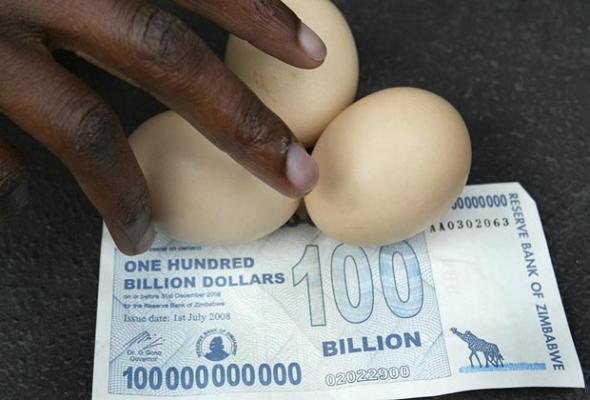
We start out not that great and end up in the same poverty amongst plentiful resources scenario just as we do in the final stage of the deflationary cycle. We have witnessed what happens to a global system and its peoples under shocks from deflationary financial capitalism in the first half of the 20th century (historically, international financial cartels appear to take over the international industrial cartels regardless of fiat or sound status of the currencies).

We have not yet seen a planet wide inflationary fiat chain of collapse yet. This would imply all major currencies on the planet being affected relatively simultaneously via some failure on the part of Bank for International Settlements strategists to react quickly enough to systemic shocks. In many ways, inflationary monetarism allows Industry a variety of tools and more breathing room to play around with prices and thus survive a while longer. Inevitably, prices rising faster than wages destabilizes the whole system as surely as wages rising faster than prices.

Implications and alternatives

It appears that BOTH paths described above eventually lead real industry into a profit collapse and corresponding large scale social crisis (factory management not having the funds to keep production and distribution running and paying the workers). This would occur even if we minimized the influence of capital allocation industry (global banking cartels) on global industrial cartels. Symbiosis and convergence of finance and industry is as organic and essential to the system as is symbiosis between industry and state, banks and state, etc.

Austrian economists have done a good job continuing where original old school Marxist economists left off (when it comes to expanding a critique of capitalism in general). Namely, they ripped into the disastrous consequences of credit growing faster than real productive economy and the "statism" that often allows this. It is rather hilarious that both Marxists and Austrian economists really rely on victory by default. That is, the former group gets legitimacy by saying the planetary capital accumulating system we had for the past few hundred years is unstable, inefficient, and ultimately unworkable even with mass state subsidies. The latter group get their legitimacy on saying the fiat version of the same planetary system is unworkable due to statist interference. "If only we could purge statism from the world system!" This absurd cry rings forth from various corners of the Western dissident movement.

One way to proceed would be to expand the credit supply at exactly the rate at which expansion of the real physical economy occurs. Some dissident thinkers believe we can bypass the inflation/deflation debate by having the state provide credit for high technology infrastructure (thus creating real economic growth). Another way to proceed would be to overlap the dying capitalist system (whatever form it'll take in the next 10 years) with energy accounting. Both can easily function in parallel for a time. Indeed, if we think of the global socioeconomic transition and experimental period in the decades ahead, overlaps and diverse systems running in parallel will be a must. Which of these experimental sandboxes will expand to swallow the imagination of the whole globe will be left for us to determine.

Stumble Upon Toolbar

Friday, December 24, 2010

Sound Money and Deflation

"With the enormous leaps in industrial productivity over the 20th century, shouldn't a penny now buy me at least 10 Snickers bars instead of nothing?" 

(Or how fiat money serves to prolong the life of capitalism while libertarians are ironically fighting to make capitalism disappear)


A great question, considering world's population rose 4.2 times from 1900-2010, annual copper mining output rose 30 times in same time period, and industrial/agricultural mass production technology (for making candy) has made exponential efficiency leaps. To investigate this serious matter lets look beyond the screams of "federal reserve and fractional lending robbed us all with depreciating overprinted fiat currency!" and delve into the underlining physical dynamics.

A one ounce Hershey's bar cost 3 cents (9 grams of copper) in 1918 whereas a 1.45 oz Hershey's bar in 1982 (last year to have 95% copper pennies) was 20.6 cents/62 copper grams per chocolate ounce. As of 2010, the Hershey's bar approximates 65 fiat cents an ounce but since the imperial authorities diluted the penny with mostly zinc (making current pennies a harder to quantify mix of zinc and copper), I'll use the 1918-1982 period for simplicity.

If one adjusts for inflation, 3 cents in 1918 is 19 cents in 1982 (539% depreciation in purchasing power). An 80 year old, lets call him Bob, getting his favorite childhood candy treat would have seen his under the mattress savings buy 6.3 less Hershey's chocolate. Now this may not seem too bad IF Bob was in a theoretical situation where his real income growth was pegged to inflation the entire life and his fiat currency grew in a bank under inflation pegged interest throughout the 20th century. Considering the candy's probable mild price buoyancy due to brand recognition, on the surface it looks like the company is only charging Bob 8% more than they did in 1918 (20.6 cents to 19).

Looking through an Austrian economics lens of inflation being an increase in the money supply, since most people do not have their finances perfectly adjusted to inflation, Bob is being continuously ripped off and impoverished via inflation tax. He may not get exactly 6.3 times less chocolate but even 2-3 less Hershey's towards the end of life is a criminal swindle.

A defender of the socioeconomic status quo in 1982 may partially agree but counter this via a pseudo-Austrian angle, "If anything Bob is lucky to only be paying 62 grams of copper per ounce instead of 9 grams in 1918 since copper is mined faster than people are breeding. He looks like he is getting a deal when using this depreciating physical metal! Copper is as fiat as paper!" (Authorities saw the copper content in penny spike more than a fiat cent in 1980-1981 period and thus changed the content, the price of copper in penny then collapsed to just under 1 fiat cent again in 1982-1984).

This is an interesting response and lets take a look at it without distracting ourselves with multitudes of other serious issues such as the government ending the use of silver in currency, going off the gold standard, stagnation of real incomes, etc. Some of these issues will begin to be resolved indirectly by the end of the article.

If one tries to look at Bob's situation via Marxist economics lens of commodity exchange, then we see that the poor fellow is being swindled in another way. This investigation is a little trickier considering technological productivity cannot be readily quantified and since the concept of productivity itself is culturally determined. What is very safe to say is that mechanical efficiency in producing an ounce of Hershey's has risen a lot more between 1918 and 1982 than the 260% rise of human population in same time period. That is, if copper production/demand magically froze in place, a 1982 Hershey's chocolate ounce should cost not 9 grams but substantially less. Surely, they've figured out ways to stamp out these chocolate treats by the millions in ways not dreamed of before (even taking into account employee salary operating expenses).

Of course copper dynamics were not frozen but they also end up benefiting Bob. If you consider the borderline exponential and evolving industrial demand for copper for electrical/water purposes throughout the 20th century, then it is clear that the 530% rise in copper production in 1918-1982 does NOT devalue 62 grams (needed to buy one 1982 Hershey's ounce) by half.

In other words, even though the copper money supply rose at twice the rate of human population, we did not see 100% inflation of the penny since the industrial demand for copper kept up pace with the human population at the very minimum. Therefore, a Hershey's bar ounce in 1982 should have cost at most 6 cents (1918 price * population growth) instead of 20.6 cents. Therefore, Bob doesn't just get ripped off through expansion of the fiat money supply but by value of goods not reflecting the breakneck pace in development of production and distribution of Hershey's bar. Considering a pre-1982 copper penny is approaching 3 fiat pennies in worth at the end of 2010 (and many countries having pulled copper from their currency in last 30 years), it may well be that a Hershey's bar should cost a lot less than a copper cent today. This makes more sense if one remembers that a silver dime from 1964 is worth over 2 dollars presently (even though annual silver output expanded 35 times in 1900-2010 period).

It appears safe to say that fiat currency was haphazardly introduced by business leaders in first half of the 20th century (via their political appointees) to prolong the life of capitalism via inflation. Ironically, the financial robber barons ended up doing the same thing that rural agricultural interests wanted in late 19th century America. 19th century saw various deflationary collapses and farmers wanted silver/gold bimetallism since rapid mining of silver would have introduced inflationary pressure on the dollar and thus prevented profit loss. Banksters 100 years ago were gold bugs since they made money from loans and deflation benefited the loan sharks. Since financial capitalist take over of industrial/agricultural capitalism was mostly complete by 1900, bankers tended to win political arguments.

During the great depression, there developed a compromise and some convergence of thought between financial, agricultural, and industrial interests concerning the benefits of inflation. Biggest bankers by that time, found a way to profit while expanding the money supply via modern money mechanics and farmers ended up getting governments to pay them to not produce too much and thus prevent deflationary profit loss. FDR managed to reconcile the key parasites, preserve capitalism, and artificially prolong the profit taking of major monopoly industries at the long term expense of the consumer (in a very humane developmental manner). Yes, he also did a lot of great things and is one of the kindest masters people saw in the last century (no sarcasm).

If the price of an 1982 Hershey's bar reflected the real amounts of hard money (commodity) availability PLUS availability of Hershey's ingredients (commodities) PLUS the cutting edge technological ability to produce and distribute the Hershey, then we'd see the company experience the periodic deflation born crisis of overproduction that the communist manifesto summarized. One can imagine what will happen to corporate bottom line if a copper/silver/gold/rare earth metal commodity money coin buys more consumer goods every year than the previous one. On paper, Austrian utopian capitalism is too efficient and benefits the consumer too much (so much in fact that it quickly implodes in deflationary collapse horror show, massive unemployment, and technologically driven socioeconomic evolutionary leap towards post-scarcity society).

It is little wonder that Trotsky sided with Austrian economists when he wrote of pre-requisites of United States going communist. They being commodity backed hard money utilized to barter for consumer goods. This is especially true for gold since gold production only rose 5.5 times in the 1900-2010 period, barely above population growth. Ironically, the current wave of libertarians are fighting to make capitalism disappear (since non-fiat currency would fully unleash the post-scarcity potential of means of production and distribution that have existed around us since at least the 1950s and that Buckminster Fuller and King Hubbert described in detail). I will leave with a few 1934 quotes from Leon Trotsky regarding the absolute necessity of ending the federal reserve. ;)


"-This system will be made to work not by bureaucracy and not by policemen but by cold, hard cash. 
-Your almighty dollar will play a principal part in making your new soviet system work. It is a great mistake to try to mix a “planned economy” with a “managed currency.” 
-Your money must act as regulator with which to measure the success or failure of your planning. 
-Your “radical” professors are dead wrong in their devotion to “managed money.” It is an academic idea that could easily wreck your entire system of distribution and production. That is the great lesson to be derived from the Soviet Union, where bitter necessity has been converted into official virtue in the monetary realm. There the lack of a stable gold ruble is one of the main causes of our many economic troubles and catastrophes. It is impossible to regulate wages, prices and quality of goods without a firm monetary system. An unstable ruble in a Soviet system is like having variable molds in a conveyor-belt factory. It won’t work."

Stumble Upon Toolbar
